

‘A Tribe Called Quest certainly is one of those essential hip hop groups, but the musicality of The Low End Theory is remarkable in itself.‘
-Broc Nelson
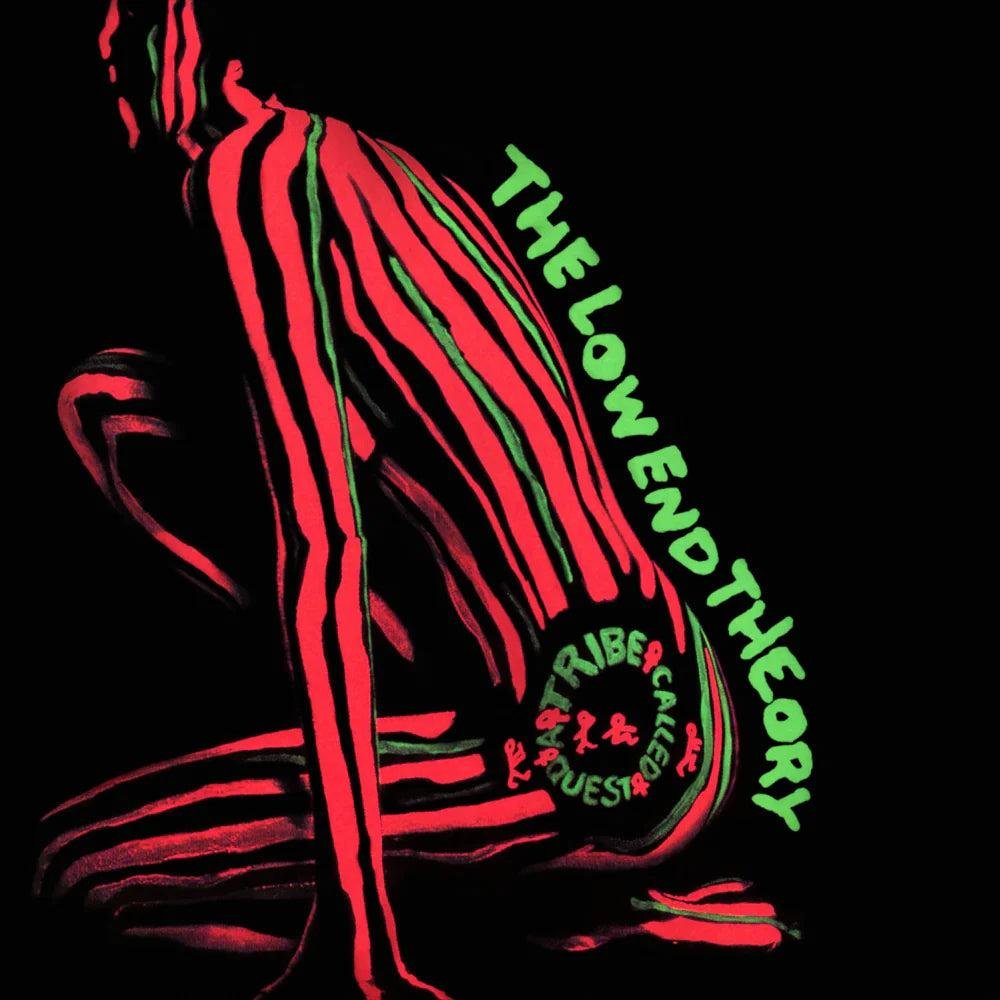
Release date: September 24, 1991 | Jive | Facebook | Instagram | Twitter | Website
Hey y’all, it’s David again. With all the talk of ‘jazz rap’ lately, divisive in and of itself, it’s prime time to talk about style progenitors, A Tribe Called Quest. We’ve done it before, but Tribe’s one of those groups that deserves a double-up when it comes to ASIR. Couple that with The Low End Theory‘s 35-year anniversary looming close and damn… it appears we’re right on beat. Come see how Ali, Tip, Phife (RIP), and many associates put together one of the best albums of all time.
Broc Nelson
The power of hip hop is multifaceted, but like many martial arts, the foundation of strong hip hop comes from its roots, the way it is grounded in rhythm and rhyme. The rhythm, stemming from the history of Black America, carries with it the legacy of African drums, used to signal and speak and celebrate throughout the ages, carried into chattel slavery where slave owners would ban drums with law and whip, keeping the enslaved from communicating across distances. The enslaved would then beat on other things, tools and implements, tables, and of course, their own bodies, finding those deep resonances within themselves to scaffold their poems and songs.
From this sense of rhythm, depth, and communication of the downtrodden came A Tribe Called Quest’s second album, The Low End Theory. The title is an announcement of the music, heavy with deep bass tones and layered kick drums meant to make your body vibrate with the rhythm deeper than any album hip hop had produced thus far up to 1991, but the title is also commentary on the downtrodden, dispossessed, and disenfranchised lives of Black Americans, not just in the early 1990s, but since 1619 and into today as the relentless scourge of white supremacy has maintained its malicious countenance leering over all who dare to posess unfavorable pigmentation and lineage.
After the relatively mild success of their first album, People’s Instinctive Travels and the Paths of Rhythm, A Tribe Called Quest, helmed by Q-Tip’s ambition, sought to change their trajectory in both sound and approach. The Low End Theory was born out of Tip’s self-assured enthusiasm, but it gave birth to an infinite number of creative avenues and artists for hip hop. You can hear it in the first bass notes of “Excursions” the second you hit play. This track is a Q-Tip solo affair, minimal instrumentation, the trunk rattling bass, plodding kick drums provide the boom to the sharp snares’ bap while Tip delivers his nasal, but persistent and precise flow.
“Buggin’ Out” follows this formula, but begins with the emergence of Phife Dawg. The five-foot assassin was on Tribe’s first album, albeit sparsely, and delivered lines written by Q-Tip. For The Low End Theory, Phife stepped up to make his presence heard, and in doing so Phife Dawg built his own legacy. ‘Yo, microphone check, one two, what is this? The five foot assassin with the roughneck business,’ he barges in with a verse full of his signature punchlines and self-deprecation that counters Q-Tip’s abstract, positive poetics. The duo share MC duties, and establish one of the great vocal duos of all of hip hop. Their voices and flows complement each other so well that, on top of the classic production, The Low End Theory becomes one of the first albums I would recommend to someone new to hip hop as an example of how impressive and musical the genre can be.
A Tribe Called Quest certainly is one of those essential hip hop groups, but the musicality of The Low End Theory is remarkable in itself. Q-Tip and Ali Shaheed Muhammad handled production, though Muhammad primarily provides scratches and embellishments while Tip wove numerous samples together to create a methodology and sound that were never before heard in hip hop and have been replicated ever since. To add to the jazz influence, bassist Ron Carter contributes to the album with his upright bass. The intent of the jazz influence was to connect generations of Black music. Q-Tip says it himself, twice. Once on “Excursions” where he says, ‘you could find The Abstract listening to hip hop/My pops used to say it reminded him of bebop/I said, “well, Daddy, don’t you know that things go in cycles?”’. Later, on “Jazz (We’ve Got)” he says, ‘I don’t really mind if its over your head/’cause the job of resurrectors is to wake up the dead.’
Since The Low End Theory there has been scores of jazz rap albums, from Kenny Segal’s production on the new Open Mike Eagle album to The Roots to Outkast to Oddisee to many, many others. This album set the pace for an entire subgenre of hip hop and cemented the connection between jazz and rap that resonates through jazz musicians like Shabaka, Makaya McCraven, and Nubya Garcia among others. The production directly influenced Dr. Dre’s The Chronic as well. The Low End Theory is one of the most influential hip hop albums of all time.
Lyrically, Q-Tip and Phife Dawg cover tons of ground, from lyrical flexing and playful moments to speaking out against the record industry, cautioning against date rape, and moments of social commentary that emerged moments before Rodney King captured the nation’s attention. Again, Phife makes a name for himself on tracks like “Butter”, but the rotating collection of Native Tongues crew members have highlights as well. Notably, “Scenario” functionally launched Busta Rhymes’s career. Nothing really compares to the interplay between lifelong friends Tip and Phife, especially on “Check The Rhime” where they introduce each other’s verses with an almost conversational series of trade-offs.
Personally, I could go on about this album and A Tribe Called Quest for a long time. The band’s history becomes more tumultuous and tragic. Phife Dawg almost didn’t make The Low End Theory as he was diagnosed with diabetes prior to the recording of the album. Jarobi is completely absent from the album. Diabetes would later claim Phife’s life prior to Tribe’s incredible comeback album, We Got It From Here…Thanks for Your Service. Sample clearing laws would also catch up to hip hop and force Q-Tip to pivot his style.
Eventually, A Tribe Called Quest would be inducted into The Rock & Roll Hall of Fame and become known as one of the most important groups in hip hop history, but it is The Low End Theory that stands as their best album. It took the idea of a ‘sophomore slump’ out back and buried it in a shallow grave. A Tribe Called Quest made some of the most agreeable music of all time. I cannot imagine even the most stringent of hip hop haters finding The Low End Theory objectionable, but for me it stands as a comfort album from a comfort group that never fails to make my head nod and remind me how much I love hip hop. This is the shit, THE shit to turn on any time of day or night to put yourself in a better mood and remind you how incredible hip hop can be.
Alex Eubanks
This isn’t true about every perfect album, and it doesn’t need to be to make it perfect, but The Low End Theory just sounds timeless. The jazz-influenced style that A Tribe Called Quest actualized here hasn’t aged a day; if anything, it’s actually managing to get better in age. It’s one of the biggest reasons I’ve been drawn to them the most out of all the big ’90s groups, nothing about their music feels tethered to a certain era – it’s completely timeless.
So much of the timeless feeling is tied to the incredible work on the production. Their sound has never fully died out the way most subgenres do when its originators step away, it just sort of comes and goes in waves. A brief bounce back in the mid 2000s, was followed by a more substantial one ten years later, influenced heavily by Thundercat, Flying Lotus, Anderson .Paak, and Kendrick Lamar’s To Pimp A Butterfly. All this coincided perfectly with Tribe’s return from hiatus in We Got It From Here… which really was a perfect storm of flawless music released at the exact right time. If the trend continues, there’ll be another wave of Tribe-influenced jazz rap coming soon.
Two of my favorite beats on the album actually are largely credited to someone outside the group in Skeff Anselm, on “Everything Is Fair” and “Show Business”. The Funkadelic sample that makes up the hook on “Everything is Fair” is so fucking good, and the baseline on the production is even better in assisting Q-Tip’s phenomenal verses. “Show Business” is one of the better beats of the ’90s, one of the best anti-industry tracks from any rap act, plus one of Phife Dawg’s most underrated verses. We won’t talk about “Georgie Porgie”.
Skeff’s stellar work on those two tracks doesn’t overshadow the incredible work from Tip and Ali on the rest of The Low End Theory. I absolutely love the dark strings on “Buggin’ Out”. They do an incredible job setting the mood for the paranoid vibe of the track and, of course, Phife’s starmaking opening verse. The smoother moments like “Butter” are just as excellent; the horns that pick up on the hook really tie the song together.
“What?” is another fun-ass beat with one of Tip’s best performances on the album, as he delivers a nonstop barrage of sometimes humorous, sometimes deep, and always entertaining rhetorical questions. Hard track to pull off; it’s a very impressive track from Tip to be able to pull it together. “Jazz (We’ve Got)” shows off a much more jazzier sound on what essentially served as a preview for the album as a lead single. I couldn’t imagine a better introduction point for the group at the time, perfectly introducing you to the group, the album, and their incredible style.
I also couldn’t imagine a better actual start to the album than “Excursions”. The beat is so simple yet so perfect up until the horns on the hook, and Tip’s writing celebrates hip-hop’s history while still setting up the complete shift in the genre they would soon start. “Check The Rhime” may be even better at celebrating their roots. Phife is so fucking good and spits every bar like he’s got something to prove, and he absolutely proves it.
“Scenario” is a rare example of a track that actually exceeds its reputation – which is wild considering it’s widely known to be one of the best posse cuts ever. Busta Rhymes gets a lot of the credit, and he deserves it. Not a lot of verses where a rapper compares themselves to a dungeon dragon, but every other aspect of the track nears that level of complete perfection. The beat is incredible, I love the ever-present echo effect provided by everyone occasionally jumping in for a word, Dinco D’s verse is stealthily elite, and it’s an excellent example of Tribe’s willingness to let guest artists take over their tracks. Rap can be a competitive game, but Tribe have always preferred to enhance their guests. It’s a rare trait.
Despite my claims about how timeless and everlasting The Low End Theory is, there are two blips on the radar. Not necessarily bad songs, just songs that do let you know this album was in fact made in 1991. Everyone involved means well, and I cannot emphasize enough that when you compare it to some of the rapey and violent shit directed towards women from tracks of the time, “The Infamous Date Rape” is incredibly progressive. However, progressive statements in their time can seem very dated when looked back on 35 years later. The song name does not help. Tip’s verses are actually pretty progressive, respectful, and thoughtful, but Phife’s verse is rough. Does the Karl Malone shout out help? No, it did not. “Skypager” is a much better song. It’s very fun and breezy, but it is a song about a piece of junk that I have never seen nor touched in all my years on this earth. I spent five minutes trying to come up with a modern equivalent, but I couldn’t come up with any useless and kinda goofy technology we have, because we live in a dystopia. A song about flock cameras wouldn’t exactly have the same vibe as stunting with a pager.
Whenever I listen to one Tribe album, I almost always have to give all of their three masterpieces (this, Marauders, and We Got It From Here…, an album that has been and will continue to rise amongst the all-time greats) a run through as well, and it always astonishes me how incredible their best three albums are. There are other ’80s and ’90s groups that can match one, almost none can do both The Low End Theory and Midnight Marauders, and no one else can claim to have pulled off the impossible and landed a flawless album 20 years after you initially disbanded. Time tends to settle most debates, and Tribe have clearly risen to a peerless state out of the groups of their era.
Toni Meese
Usually, there are two approaches I consider for ASIR. Either, I go the informative route – delving into an album’s whereabouts and history, maybe some interesting stories surrounding it, and ideally, a contextualization of the album’s place in the wider scope of music culture. Or, I share something personal. Since the album in question today happens to be one of the most influential and important (conscious) rap albums of all time, I leave it to my mates to cover that. All I wanna do is share a little anecdote with y’all.
In my teen days, I downright antagonized hip hop. I didn’t even consider it proper music – I was uninformed and ignorant, disliking art out of principle because it was opposing what I liked about art. Fortunately, I eventually grew out of my “dumb teenager arrogance” and eventually branched out into music which wasn’t metal or hardcore. Still, it took me quite a few more years until I decided it was time to give rap a proper inspection.
I didn’t particularly know anyone who was really into hip hop, so I think the first thing I did was to search for essentials. Which albums do you need to check out to get into hip hop? I found a list with a predominant 90’s focus, so I delved right in. I remember bobbing my head to N.W.A. and Wu-Tang Clan, Snoop Dogg‘s Doggystyle, Public Enemy was fun, vibed with Xzibit‘s At The Speed of Life for some reason – generally, I had a good time with a lot of the stuff I found.
Nevertheless, there were two albums which stood out so much that I still vividly remember how bamboozled I felt for neglecting rap for so long. One of them was Mobb Deep‘s The Infamous, and, yes, you guessed it, The Low End Theory.
Jazz was already something I loved back then, so all the rap, which had some obvious jazzy influence, came pretty easy to me. A Tribe Called Quest felt chill and jazzy, and I was immediately drawn to it. I didn’t understand the words back then (English is not my first language), but I loved the beats, the samples, and flow of so many of the rappers involved, primarily Phife Dawg and Q-Tip.
This album is easily the most important rap album for me – it determines my preferences for hip hop to this day, like no other. So thanks for that. Also, if you never listened to The Low End Theory, why, and more importantly, when will you change it? Soon?