

‘But for whatever anyone else says, Hats is an album that clearly spills from the heart of the band who wrote it.‘
-Iain Ferguson
Release date: October 9, 1989 | Linn / A&M | Facebook | Instagram | Website
Label interest and artistic vision rarely go hand in hand; many albums can tell a story or two about that fact, but the sheer amount of pressure and struggle that went into Hats, the 1989 masterpiece by Scottish art pop legends The Blue Nile, sets it apart from the pack in that regard. Five strenuous years of setbacks, label demands, writing, and rewriting resulted in one of the quiet masterpieces of the ’80s. It’s a miracle we even got to have this record in the first place.
Iain Ferguson
Rain-slicked city streets, full of the promise of life but currently vacant. The last, lonely patron at an upscale bar at closing, gripping with the fact he’ll be going home alone again tonight. A nighttime train ride out of town, quiet and pensive yet marked with the knowledge that there’s warmth waiting back at home. I’ve always been a sucker for albums that paint a picture, and The Blue Nile‘s Hats is one of the strongest in that regard.
Scotland’s The Blue Nile was heading for some great things upon the 1984 release of their debut A Walk Across Rooftops. Bolstered by the success of “Tinseltown in the Rain” and some great critical reception, the band’s label demanded new material. And that material just didn’t happen for a while. Under the pressure of label expectations, no prepared material, lawsuits, internal strife, and burnout, it wouldn’t be until 1989 that The Blue Nile finally felt strong enough with their material to release their sophomore album Hats. But you know, sometimes good things come to those who wait.
Above most other albums, Hats is the type of record that I’d easily describe as ‘pure vibe’. Leaning on a sparse, atmospheric and arty approach to synth-laden sophisti-pop, Hats is the type of album where the refrains don’t have to be sharp to get you hooked, and the languorous mood that permeates the album winds up absolutely engrossing and emotionally resonant. Somewhere between the smoothest textures of Roxy Music and Bryan Ferry, a low-complexity alternative to ’80s King Crimson (singer Paul Buchanan reminds me a lot of a more soulful Adrian Belew), and the artistic merits of Peter Gabriel (one of The Blue Nile‘s most noted supporters), Hats works its magic.
From the opening notes of “Over the Hillside”, the band’s methodology is clear. Sparse drum machine patterns, hazy synths, and distant guitar textures underpin Buchanan’s emotive voice, speaking to the hardships and redeeming qualities of life. The light trumpet and strings that join in later add a soft cinematic flair, but Hats is a very personal-feeling album. “The Downtown Lights” has a more noticeable beat to it, but its lamenting lyricism keeps it from ever threatening to feel bouncy. It’s probably “Headlights on the Parade” and the absolute beautiful, unassumingly romantic “Saturday Night” where The Blue Nile gets the warmest and brightest, tinged as they are with bittersweetness.
As it happens, my own favorites on the album (besides “Saturday Night” because it’s gorgeous) tend towards the gloomier moments. It’s almost impossible not to sink into the mood of “Let’s Go Out Tonight”, an ode to reaching from solace from life’s hardships through love. Even that comfort feels gone on “From the Late Night Train”, which is about as despondent as the album gets while consisting pretty much solely of piano, trumpet, and voice. But even then, The Blue Nile had the foresight to let “Seven A.M.” bridge that emotional low point to “Saturday Night” by way of one of the artier songs on the album, throwing in an unexpected, understated funk riff over its pulsing drum machines deeper into the track.
For the curves in its textures, Hats is a beautifully cohesive album that doesn’t let listeners go. For whatever hardships the band had to face to create it, Hats is nigh flawless and has been a quieter favorite of mine since I was introduced to it by my co-host from an old podcast. To a degree, it’s a shame The Blue Nile hasn’t had a more prolific career (four albums over a course of a 23 year run), but one can’t argue with the band’s process when the results are so damned good. Of course the band won plenty of fans, including the aforementioned Peter Gabriel and Rickie Lee Jones, and they’ve left an influence that ranges from artists like The 1975 (apparently, Matty Healy cites The Blue Nile as his favorite band and Hats as his favorite ’80s record) to Dream Unending, who directly referred to Hats as a huge influence on their ‘dream doom’ sound. The Blue Nile and Hats are both regular fixtures on retrospective Best Of lists from numerous critics and publications, and I’d be hard pressed to disagree with them.
But for whatever anyone else says, Hats is an album that clearly spills from the heart of the band who wrote it. It’s emotional, enveloping, and even if it had marked the end of The Blue Nile, their place in music history would have been firmly guaranteed at its release. If you’re not familiar with Hats, but you have a love for atmospheric music and the moodier, artier end of pop songwriting, I’d be surprised if Hats didn’t end up being one of your own favorites too.
Joseph Krebaum
To my surprise, the Scottish sophisti-pop band The Blue Nile took about five exhausting years to record and release Hats, their cerebral follow-up to A Walk Across the Rooftops. When the band finally had an album-length set of material, they scrapped the entire thing and began from scratch, dissatisfied with the initial results and feeling burned out by constant label pressures. It was only once the core trio of Paul Buchanan, Robert Bell, and Paul Joseph “PJ” Moore was forced out of the studio and came back home to Glasgow that they overcame their writer’s block, and rather quickly so.
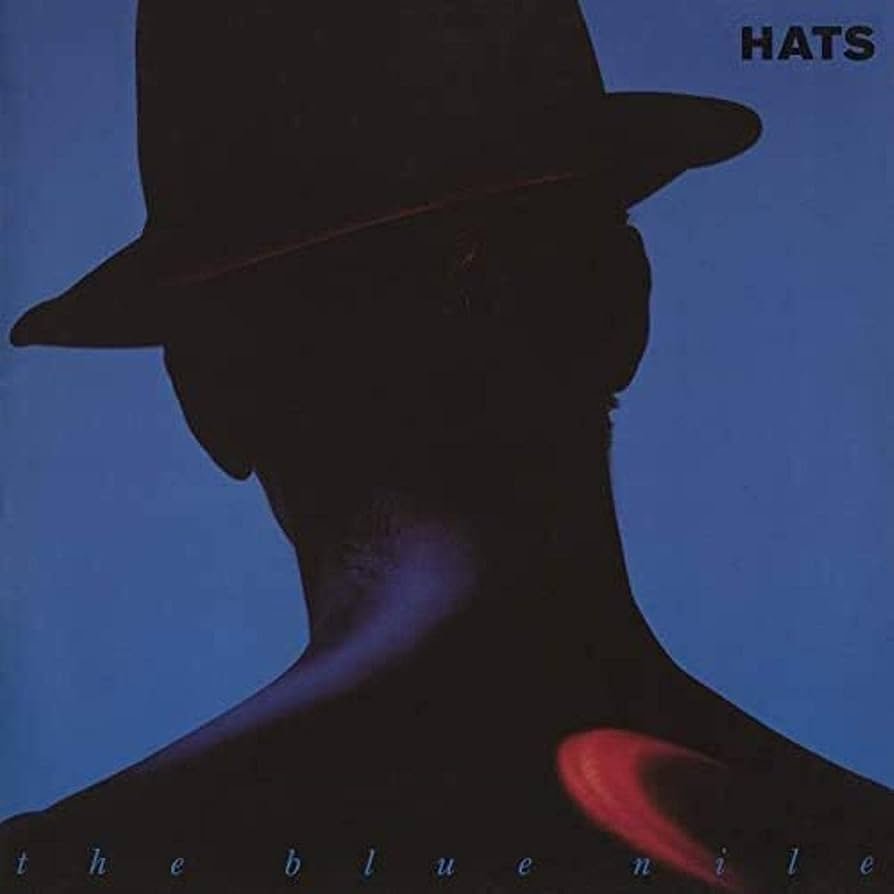
Hats, the end result, is an unusually tranquil listen for what seems to be a record primarily about a night out on the town. Any other 1980s soul-infused synthpop act would have sounded mawkish at attempting this, but The Blue Nile’s Sinatra-esque glide comes across as fully lived-in – a love letter to Glasgow’s nocturnal atmosphere. Look no further than “The Downtown Lights”, the album’s synths-forward centrepiece. This is The Blue Nile sounding simultaneously upbeat and elegant as ever, coasting on synthesized ambience and Buchanan’s subdued delivery. I listen to this song, and it’s as if I’m listening to an old Edward Hopper painting, striking a balance between negative space and noir. That’s also the vibe I get from Hats’ album cover depicting the back of a man wearing a top hat against a solid blue background.
Other tracks, such as the bookends of “Over the Hillside” and “Saturday Night”, are carried by a drum machine’s soft but steady pulse, with just a touch of reverberation. ‘Gentle and slow’ appears to be the mantra for much of The Blue Nile’s follow-up LP, with one track, “From a Late Night Train”, excluding percussion altogether and adding in some brassy tones. Buchanan sings his lovelorn lyrics with both soul and conviction, helping to elevate the group’s limited instrumental palate. The fact that the trio self-produced Hats might even astonish some people considering how sophisticated – for lack of a better word – everything sounds.
The question I keep asking myself with Hats is this: how does this project rise above the rest of sophisti-pop’s brethren? As a reminder, this also came out in 1989, the same year as other landmark albums like Pretty Hate Machine, The Stone Roses, Disintegration, The Mind Is a Terrible Thing to Taste, and so on. Furthermore, is The Blue Nile’s influence still felt today?
It’s complicated. While they may not be as immediately hooky as Kate Bush or Sade, I could easily argue that their elusive status has only heightened their popularity, both inside and outside of their sophisti-pop and synth-pop genre banners. They don’t make music anymore, yet they continue to be fondly remembered by a fresh wave of pop and indie pop musicians – from the recently-passed Duncan Sheik (rest in peace) covering The Blue Nile’s “Stay” to critically-acclaimed auteurs Wild Beasts. Prior to their moments of success, Annie Lennox worked with the band once for her solo career, as did Rickie Lee Jones, who made them her opening act, and even the legendary Peter Gabriel!
Sophisti-pop is mainly a retrospective tag, so aside from Jessie Ware’s albums during the 2010s, there hasn’t been a substantial revival of this exact style lately, much less The Blue Nile’s spacious minimalism. I mean, how exactly can one feel nostalgic for something that didn’t even have an identity until years after peaking in popularity? Imagine if disco wasn’t even formally referred to as disco until 1984! This is the thing with The Blue Nile: they may not have been classified as anything specific at the time, but they obviously knew what they were doing for future generations.
If younger artists like Black Midi, The 1975, and Taylor Swift can appreciate the shimmering beauty of “The Downtown Lights” and pass it on to their devoted fans, then Buchanan, Bell, and Moore surely created something more than just Spandau Ballet, labels be damned. In an era where revivalism and nostalgia have been reduced to regurgitated AI fodder, The Blue Nile’s second full-length effort reminds us of what matters most in art: the human experience. Sure, the lyrics are simple, and the production tropes of the 1980s are in moderate effect, but at the risk of sounding dated, the music still lives and breathes more soul than any half-hearted attempt to revive the sound. It’s melancholy. It’s longing. It’s sweet. It is the essence of all that The Blue Nile does best.