

‘The Colour of Spring is easily one of the best albums of the 1980s and has permanently altered my music tastes.’
-Broc Nelson
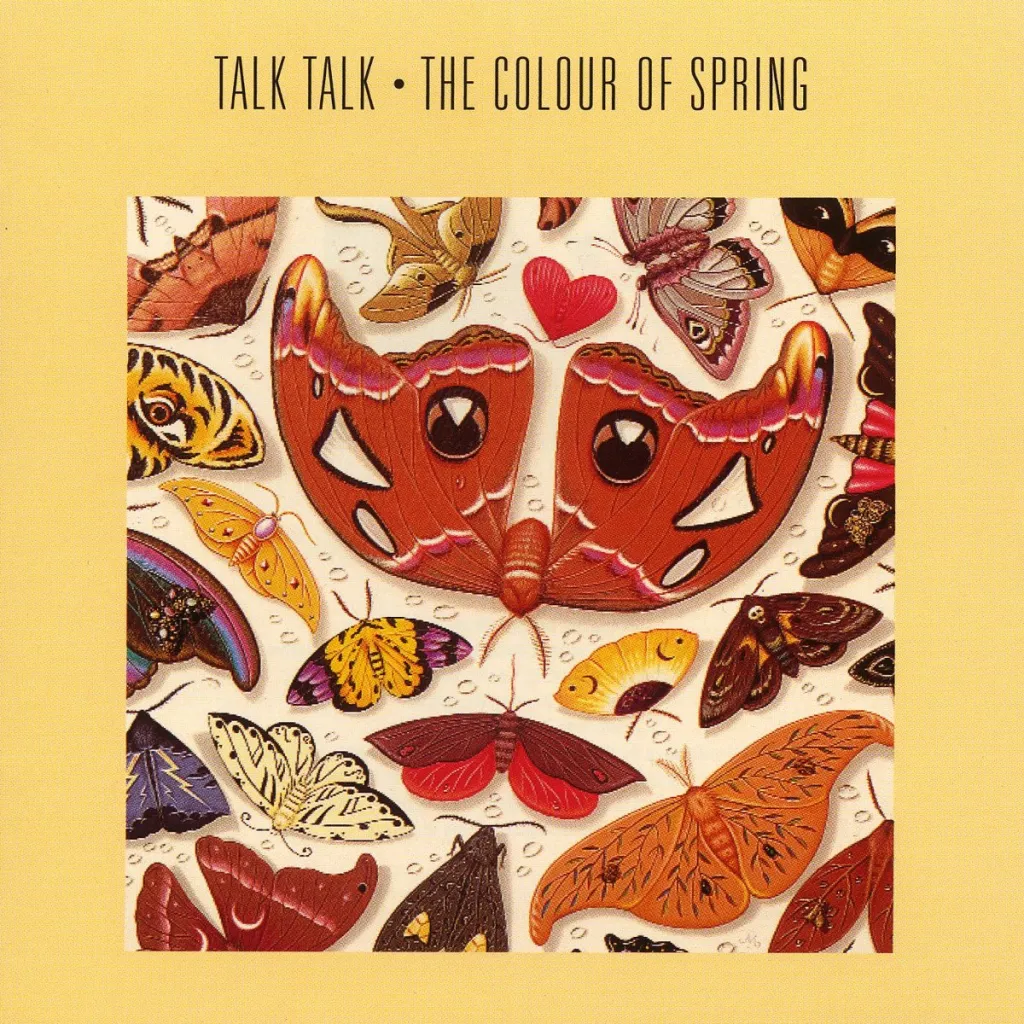
Release date: February 17, 1986 | EMI Records | Facebook | Instagram
The 40th anniversary of Talk Talk‘s landmark album, The Colour of Spring, was back in February, but what better time time to listen listen to its spring-evoking new wave/pop intricacies than when the gloom is taking over? It’s ’80s music majesty from the UK, moody and pleasantly sophisticated all in one. This chart-invader speaks for itself, but who could pass up the opportunity to write write about Talk Talk? Certainly not our Broc and Iain who will be taking it from here!
Broc Nelson
Talk Talk has always seemed like one of those bands that is more loved by other musicians than by music fans. I’m an unpracticed, terrible musician, but I have played a couple of concerts and recitals. Perhaps that mediocrity is why it took me a while to get into Talk Talk, They didn’t click at first, but then again, my first experience with them was listening to their classic albums Spirit of Eden and Laughing Stock, two exercises in minimalism and sparseness that were inspirational to ambient artists and the genesis of post-rock. I was listening to a lot of stoner metal and other wall-of-sound type music at the time, so the contrast was too powerful to hold my attention.
I would revisit these albums from time to time if only to get a sense as to why they were so highly regarded, and eventually looked further back at their earlier albums. “It’s My Life” was immediately recognizable as a major radio hit, furthered by Gwen Stefani’s cover also getting heavy airtime, and as a fan of new wave, these songs were more my speed. Next, I tried The Colour of Spring, and that’s when the brilliance and enigma of Talk Talk finally resonated with me.
“Happiness is Easy” immediately draws you in with a drum beat that could almost be a hip hop beat with some jazzy shuffling, but the way the bass, piano, guitar, and Mark Hollis’s mournful clarinet of a voice join the percussion is a masterclass in sophistipop. This song feels lightly funky and cinematic at the same time, but when the ultimate secret weapon of a children’s choir enters the chorus while the rhythm simplifies you cannot help but be transfixed (seriously, who doesn’t love a surprise children’s choir?). Saxophones, acoustic guitars, and church organs join the tune as Hollis lays out his sharp critique of blindly following organized religion.
The intricate composition, far removed from synth pop, announces The Colour of Spring as their transition album into more experimental sounds. Despite and because of this, The Colour of Spring is their biggest commercial success, with their final two albums impressing critics more than consumers. This success was lead by singles “Life’s What You Make It” and “Give It Up”, but it also signaled that more mature sounds could be big sellers. The former of these singles was almost an afterthought, composed after their label expressed concern that the album didn’t have an obvious single. It remains one of their best-known songs, and its relative bounciness and hooky chorus fit nicely into the flow of the album interrupting the slower, more ambitious tracks with immaculate pop sophistry. The latter track does the same trick on side B.
The songs surrounding these singles, though, are where the magic bridge between being a good new wave band to being a legendary experimental act. “April 5th” is a gorgeous, meditative ballad. “Living In Another World”, on the other hand, is a post-punk via new wave powerhouse that would equally make sense as a single, showcasing Talk Talk’s unique palette with a harmonica solo. Closing tracks “Chameleon Day” and “Time It’s Time” push the experimentation further.
“Chameleon Day” is a minimalist piano ballad until it gets weirder at the end, sounding like a prettier Xiu Xiu. 8 minute closer, “Time It’s Time” is a breathtaking culmination of all of the strangeness and pop sensibility that lead us here. This track is just a crazy combination of sounds that seems distinctly of the 1980’s while also unlike anything since. The church choir that keeps a key changing rhythmic chant going throughout the chorus is (once again) incredible, used like a tense moment in an opera only to open the music up to a light, jaunty, infectious pop hook that predicts the kind of melodies 2000s indie rock made famous.
The Colour of Spring is easily one of the best albums of the 1980s and has permanently altered my music tastes. While writing this I realized that any album that gradually introduces new instruments into each track over catchy, melancholic vocals with thoughtful lyrics is cat nip for me. Three of my favorite albums over the last three years have shared this formula, this mood of experimental pop. Beth Gibbons, Hilary Woods, and American Football at various points over their most recent albums have made me think of Talk Talk. It is like a guarantee that I will love it. So far, it seems to be working. Albums that get this right are few and often far between, and The Colour of Spring is the gold standard of those rare, special albums.
Iain Ferguson
One of the stickiest, yet most interesting contradictions in the music industry is when artistic vision runs headlong into budget. It’s a matter that transcends era and genre, and we’ve all heard plenty of albums where we can note the audible tears of ambition struggling against seams of material reality. Of course, sometimes the musicians involved actually do succeed to a strong enough degree that they can fund their full ambitions, with results that can either be just too much, or positively stunning. Back in 1986, Talk Talk found themselves right on that threshold.
In all fairness, Talk Talk‘s early albums were genuinely great synthpop and very well received. Mark Hollis and company gave it their all through The Party’s Over and It’s My Life, and had they splintered there or remained in that synth, yet deftly artful new wave groove, I’d bet that people would still remember Talk Talk fondly to this day. The thing is… that wasn’t the band Talk Talk wanted to be. Mark Hollis went on record saying he genuinely didn’t like using synthesizers and only relied on them as a matter of budget. When it came time to record The Colour of Spring, alongside producer and dedicated cowriter Tim Friese-Greene, the band had scored enough success to swing a little higher, leave behind their synthpop roots, and really bloom into the unique, multifaceted entity we all love and respect now.
The Colour of Spring marked a genuine watershed moment for Talk Talk. A flourishing of Hollis and Friese-Greene’s ambition. Eschewing the more slick, modernized sounds of their first two albums, The Colour of Spring is immediately a far more textured, jazzy album than its predecessors. Choruses hold less weight, and the structure of many songs feels more free and flowing than the tightly composed hits that had previously marked the band’s repertoire. Hell, some songs almost feel like loose sketches composed into a nearly improvised manner.
More vitally, the band leaned hard onto non-synthetic instrumentation this time around. Pianos, organs, and the odd Mellotron supplant practically any trace of synthetic instrumentation, acoustic guitars take over the bulk of the string work from their electric brethren, and the drumming is far more airy and alive than the pulsing electronic drums Talk Talk had previously utilized. The one truly obvious connecting thread from their previous work is Hollis’ distinctive singing.
That’s not to say Talk Talk lost their knack for writing an absolute earworm. Like many people my age (i.e. people born after the band’s entire recorded output was released), my first knowing exposure to Talk Talk was via Grand Theft Auto: Vice City, where “Life’s What You Make It” quickly caught my ear. Written as a challenge after the band was told The Colour of Spring lacked obvious singles, the pulsing drums, insistent piano, and screaming guitar hook that comprise “Life’s What You Make It” are nigh-on guaranteed to hook listeners, and made for the band’s final conventional radio hit.
Of course, other catchy songs emerge throughout The Colour of Spring. “Living In Another World”, with its grand scale, impassioned singing, not to mention that awesome harmonica refrain, is most likely my favorite song across the whole album. Meanwhile, the much more smooth and low-key “Give It Up” has an obvious singalong hook bolstering its more laid back flow. “I Don’t Believe in You” hits a similar territory, dumping an abundance of soul across its naturalistic soundscapes.
And then there are the songs where Talk Talk was signposting what had yet to come. The opening “Happiness is Easy” takes nearly a minute to feature more than its jazzy drum intro, featuring verses supported by smooth upright bass and the addition of a children’s choir delivering its refrain. “April 5th” is even more sparse and loose, feeling akin to a flowing musical stream of thought with the odd ripple of additional instrumentation cropping up as needed. “Chameleon Day” fully utilizes silence as its own instrument feeding into “Time It’s Time” which closes things out with ominous choirs and eventually melodica across its breadth.
It’s these more artsy track where Talk Talk showed the true ambition lurking within; come Spirit of Eden and Laughing Stock, the band was set to become one of the formative post-rock bands, and (let’s be honest here) one of the best. Those albums would mark the band fully divorcing from pop and stitching together their songs from hours of improvisations and overdubs. For a good span of time, I would have cheerfully called those albums my favorites in Talk Talk‘s canon, but in revisiting The Colour of Spring, I realized that it’s genuinely a perfect bridge between eras and probably the finest in my own eyes. Catchiness and exploration sit hand in hand, often within the same song. The typical pop instrumentation of the time is gone, but it still feels more focused than the anything-goes approach of the albums that would follow. The Colour of Spring is really the best of both worlds.
And all of that is before even getting into the cast of session players who helped elevate the album. My own favorite presences are regular Peter Gabriel collaborator David Rhodes handling that sweet guitar hook from “Life’s What You Make It” and the absolute legend Steve Winwood sitting in on organ for multiple songs (best noted on “Living in Another World”). But really, everybody across the album brings their A-game. Beyond this point, the core Talk Talk lineup would become a bit less of a constant before the band’s dissolution in 1991. Lee Harris (drums) and Paul Webb (bass) would go on to form the similarly experimental but more world-inflected .O.Rang, while the former did a stint in the fellow vitally important post-rock progenitors Bark Psychosis. Tim Friese-Greene kept doing music as Heligoland alongside his production credits. Mark Hollis, meanwhile, stepped away from music to focus on his family, only coming back for a solo album in the late 90’s before retiring from music and eventually passing away in 2019. Talk Talk, for their part, only existed for ten years and five albums, but that’s all it took for the band to cast a huge, influential shadow far outweighing their brief commercial viability.
The Colour of Spring remains probably the key album in Talk Talk‘s discography. A marvelous best-of-both-worlds album featuring their formative pop craft just as heavily as the later artsy, proto post-rock (as ridiculous as that feels to write) spirit that was rapidly blooming. Moreover, it’s just an album full of great emotions, phenomenal songs, and soul, rendered much more organic and personal by its drastic reduction in electronics and heavier reliance on low tech instruments and an earthier, more roomy production style. It’s one of those moment-in-time albums where everything that ever defined Talk Talk got distilled into one pure, near perfect package. So hey, if you’re down from the encroaching cool of autumn and the approach of winter, why not reach for some comfort from The Colour of Spring? It’s been working just great for the past 40 years, after all.