

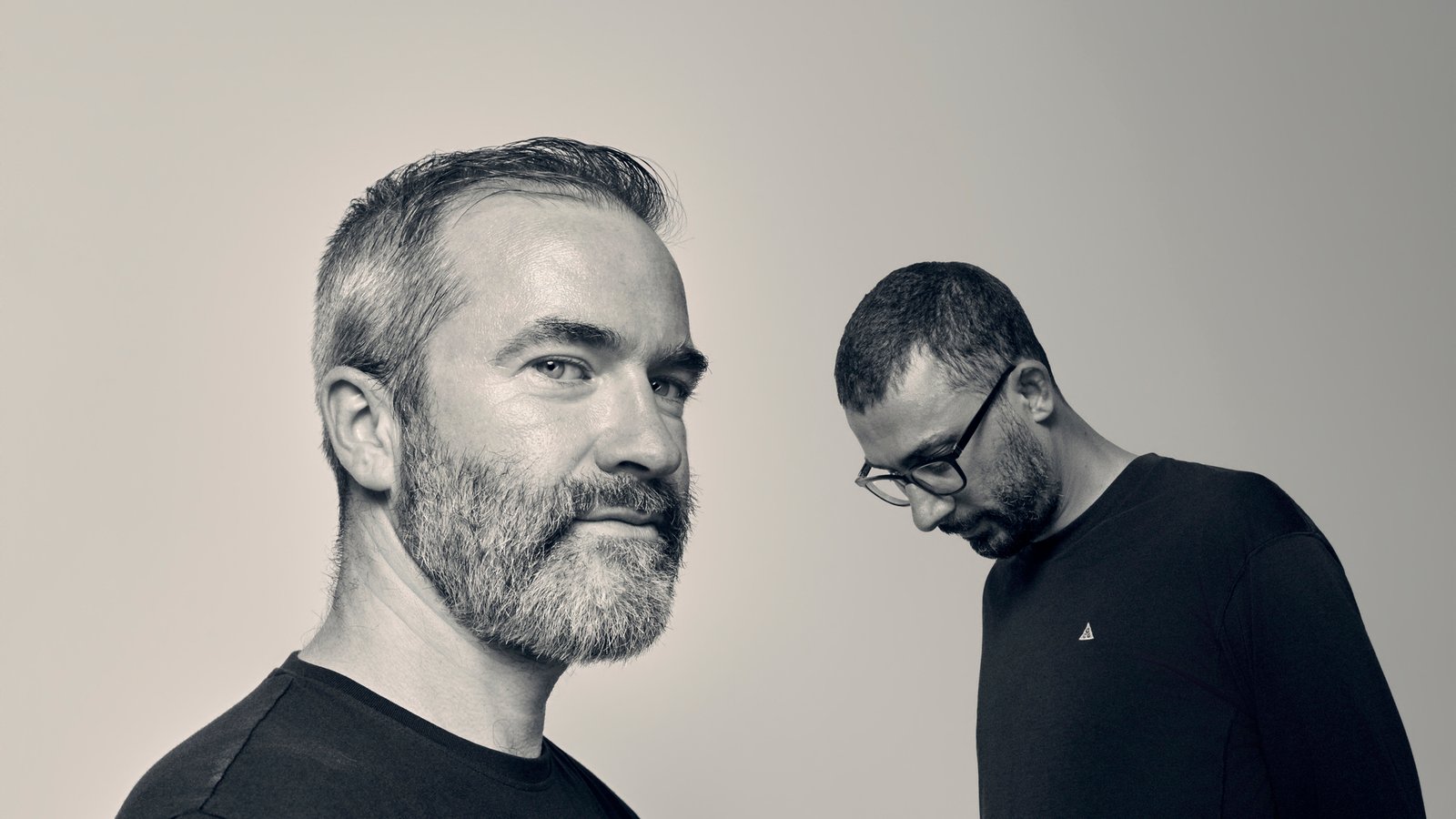
Producers Saint Abdullah & Eomac disrupt the concept of every border through hip hop and electronica on When The Sandbox Has No Edge.
Release date: October 16, 2026 | Planet Mu | Instagram | Bandcamp
I’m going to open this by taking issue with the common definition of a ‘concept album.’ Traditionally, concept albums center around a narrative story, common in progressive rock, but certainly not limited to it. These albums tell a story, sometimes from different perspectives, sometimes there are musical motifs, but almost always concept albums rely on a traditional storytelling arc of exposition, conflict, rising action, climax, etc. When artists stray further from that kind of narration, perhaps taking the concept into something more thematic, compositions of individual songs meant to be performed sequentially centered around a given idea, we call them song cycles, though the practice and terminology are becoming increasingly archaic. I think these are important distinctions, but When The Sandbox Has No Edge, the latest album from the producer group of Saint Abdullah & Eomac demands that we broaden the definition of a concept album or better yet, refer to traditional concept albums as narrative albums.
The New York duo Saint Abdullah, often joined by Irish producer Eomac, were inspired to create their fifth album, When The Sandbox Has No Edge, by a piece of poetry read aloud in a taxi cab, and the resulting title lends a thematic element to the album, betraying conventions of hip hop, dance music, and electronica by sonically exploring places beyond any of those genres’ typical borders. Guest poets and rappers amplify the hip hop angle on some tracks while guest musicians and sound designer Seraphim help further erase the borders in which the trio play. We are left with a sound that is equal parts collage, deconstructed club music, and hip hop that careens with the energy and joy of discovery that defines hyperpop while maintaining the gravitas and complexity of seasoned artists. In short: When The Sandbox Has No Edge is hard to define and fun as hell.
While the bombastic production may be exhilarating, the subject matter is serious. “Willing In the Name Of” (featuring Seraphim) opens with a sample that says, ‘the truth seems to be scaring ’em/a war’s goin’ on outside, but who’s preparing ’em,’ before a blitzing hand drum lead beat speeds forward like the climax of an acid jazz lead raga. There is nothing subtle about the opening tracks. “Gusgazzler” pushes through with the kind of distorted bass and dense production that El-P and The Bomb Squad pioneered. Many languages and cultures work their way through the samples on this album, as genre lines blur, so do political borders. A dominant them of this album is about global unity, maintaining respect for each other regardless of the imaginary lines left from imperialism, colonialism, and the violence it takes to maintain those borders.
“Sufism And Suffering” offers a brief moment of adorableness on this otherwise frantic and intense record where a little girl describes how she wants a song to go, ‘...and then, it goes so crazy, then it goes much crazy and all the lights are flashing with rainbow, like sparkles, and then I want…‘ The group delivers with an increasingly, mid-tempo track built around a funky dub bassline on the following track. This moment may be a great intro track, but it also reminds us why we must think of borders as a relic of violence to be eliminated. There are children now who need safety and stability that they cannot find in their home countries, and these migrants and refugees are a small precursor to what will come in the following years as water shortages, drought, natural disasters, and intense heat displace billions through necessity and conflict.
Armand Hammer lend their domineering poetic voices to “As We Are”, a duo that equally reside in the complex thoughts of what it means to live under end times capitalism while carrying the weight of centuries of oppression. ‘We don’t see things as they are, we see things as we are,‘ offers the refrain from E L U C I D, open to interpretation but easily speaking to how material conditions can alter perceptions of the lived experiences of others. This track calls to mind the wandering and eclectic production on We Buy Diabetic Test Strips. It also kicks off a run of somewhat calmer tracks that include the quietly beautiful “Whiff Tickle” (featuring Che Chen of 75 Dollar Bill), a sonata lit by a mere sliver of moonlight and the flickering neon lights of a closing club with Che Chen‘s guitar weeping soulfully in the coda. Abdul Hakim Bilal and Seraphim lend hands to disrupt this paranoid calm with the noise-rap of “Absolootlimb”, the former dropping killer anti-colonial bars between machine-gun static bursts.
The edges that once restricted the play area aren’t just political borders. Saint Abdullah & Eomac disrupt the borders of the past, present, and future with their samples and synth work. The borders of relationships are shattered with the poetry of Richie Culver on “Deleting Your Horoscope” (also featuring Seraphim). “Cipher Becomes Sifr” breaks the borders of cell phone addiction, language, and intelligence through the rhymes of multi-disciplinary, British-Iranian artist Abbas Zahedi on what may be my favorite track on the album. The Iranian presence is heavy on this album, making a poignant statement of humanity during the United States and Israel’s war against Iran. The album art is even by Iranian artist and architect Elham Goodarzi who manipulates archival photos taken by Europeans across Iran, Syria, Iraq, and Palestine, turning ancient structures and ruins into surreal structures that recontextualizes colonial curiosity into defiant digital folk art.
Like The Diamond Sutra invites one to cut through dualism with the unforgiving sharpness of a diamond, Saint Abdullah & Eomac unabashedly play When The Sandbox Has No Edge, throwing frantic dance parties, biting poetics, and moments of introspection into a frolicking political and artistic statement that defies easy categorization as much as it defies the shackles of psychological and artistic rigidity. This album explores the central concept of the title thoroughly, with unrestrained, astounding results. No other album this year has provided moments of frustration, beauty, joy, awe, fun and bewilderment like When The Sandbox Has No Edge. This is excellent art.