

A sound design artist and a noise legend join forces for an impressive, whimsical, and surprisingly deep experiment in sonic manipulation.
Release date: May 29, 2026 | Superpang | Bandcamp
Masami Akita, the man behind the harsh noise institution that is Merzbow, has gone through several different phases and shifts throughout his career. Despite having released music for over forty years now, his records over the last decade show the mark of an artist that knows the secret to rejuvenation through constant artistic creation: taking inspiration from new sources, and collaborating openly and frequently. These collaborations are by no means a new development in Merzbow’s work, but, starting with 2014’s joint album with Full of Hell, their scope, nature, and profile has certainly grown more significant.
On Rococo ∞ Echomatter, the Japanese noise demon teams up with not another musician or electronic producer, but with Kikù Hibino, a Japanese-American sound artist from Chicago; someone whose works usually find a home in art galleries and museums, not dingy autonomous spaces or basement-level live music venues. This partnership brings out a different aspect of Akita’s musical prowess: measured, heavy on the textures, reserved with the big sound swings, and deceptively mesmerizing.
This isn’t just how things happened to manifest themselves, of course. As Hibino shared in an interview with Loudness, the work on the album had a very specific concept for how the noise element should be integrated: ‘The process felt tense, almost like cutting into someone else’s long hair with scissors. But that kind of editing was necessary to avoid chaos and build a new structure. In that sense, the making of this track was less like traditional composition and more like a very deliberate editorial intervention.‘
This deliberate editorial approach is strongly felt throughout Rococo ∞ Echomatter, a collection of tracks marked by the tensions that propel it forward: unmanipulated, unassuming vocal samples popping up under flashes of bubbling synthesizer oscillations and bleeps; Merzbow’s overwhelming noise attack spliced up and manipulated by Hibino’s thoughtful clinical approach to sound design; free-jazz freakouts constrained by traditional, radio-friendly song lengths. As an album, it is a masterclass in how, when handled with capable technical abilities and a clear artistic vision, ferocious harsh noise can be shaped into an elegant, restrained beast of sharp edges and metallic sheen.
Throughout its compact runtime – just 31 minutes – the record manages to explore a pretty varied spectrum of sounds, juggling multiple sonic directions during each track without losing the listener. The key to this is the tension that Hibino and Akita build and maintain, with even the most chaotic moments never going too far beyond Rococo ∞ Echomatter’s clearly defined sonic identity. Take the second track, “saxxxrum” with its saxophone-led bursts of energy which harken back to Akita’s roots as an avid fusion and psych fan. The track, which features Japanese-American musician Patrick Shiroishi, climaxes in chaotic noise swells and synth pad stabs before giving way to a single sustained saxophone note, then ending with a deep bass hum that offers immediate relief. Those few seconds of stripped-down sounds and audio channel disruption are the moments where the listener reorients themselves, and they demonstrate a strong understanding of dynamics and momentum.
The following track, “Oni-araignée”, marks the second appearance of Alexandra Cupșa‘s vocals (the first being on the first track). This time, her voice ist set against a clashing and oscillating backdrop of Ant-Zen–inspired rhythmic noise and eerie string instrumentation. The creepy, tense-to-the-point-of-breaking use of strings on this track reminds me of Runzelstirn & Gurgelstock’s infamous Asshole/Snail Dilemma album, which is a very big deal, as I have been searching for ages now to scratch that particular sonic itch again. A million years into his career as an artist, Merzbow still has new tricks up his sleeve, and that is seriously impressive.
Keeping up the momentum is “∞ Echomatter”, where the ominous sounds of droning dread are soon met with whimsical Vaudeville piano lines and 8-bit chirps. In another testament to just how much thought Hibino and Akita have put into piecing together this record, the widely disparate sonic elements work incredibly well together, crafting a track that is the album’s masterpiece: scary, otherworldly, hypnotic, and jittery – all at the same time. It has a unique feel that is really hard to put into words, but maybe this will help paint a clear picture: this is the closest that a noise track has ever brought me to tearing up.
How its follow up, “Prinsesstårta”, starts should also be studied in sound design schools: gurgling noise shaped into melancholic stabs, torn up by the return of Cupșa’s nonchalant vocals. The track trudges along like a weird, electrified funeral procession, before finally opening up to the more traditional noise assault of “BAAROQUE”.
The penultimate track, “ƒƒƒ fraa filum flammm” – the final boss of challenging track titles – incorporates vocals from psychoacoustic specialist Matchess in a much more genre-obedient manner. Her vocals, softly spoken, are difficult to really understand yet persistent, barely holding together a shapeshifting sonic odyssey in miniature form. It’s an appropriate pre-closing piece for this majestic record, sticking the landing with a heavy, loud, and somber sound, before closer “abcdefg” turns everything on its head with nonsensical lines and a final thundersrike of harsh noise to remind us that the whimsical, no-fucks-given elements of the genre are still there. In some ways, it’s an ending fitting to the album’s cover art: an image of an ornate rococo ceiling, covered in black paint smudges.
If, like me, you are more of a Merzbow casual than a completist, I strongly advise you not to skip this record. His work tends to benefit tremendously from teaming up with the right collaborators, and in Kikù Hibino, it is clear that he has found one. The alchemy of their partnership results in a confident, smart, and at times even emotionally evocative noise record; one that I will be spinning a lot this year, and one that would be very difficult for any other noise artist to best. If anyone needs any more proof that Masami Akita is the GOAT of noise, consider this the closing argument.
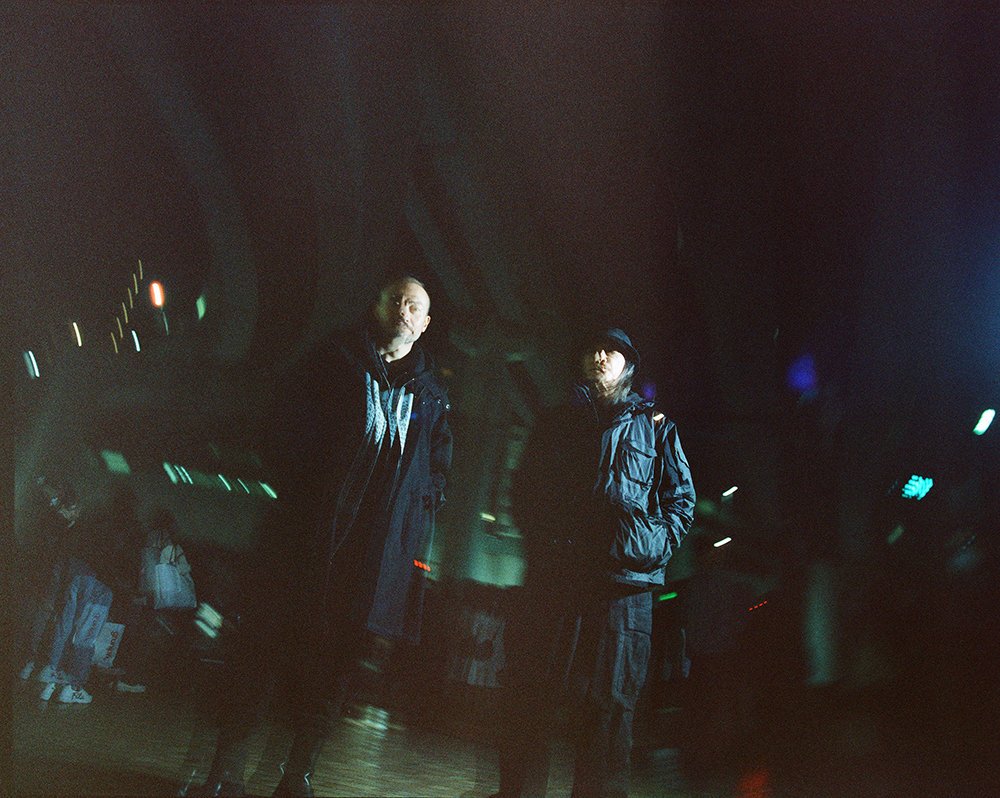
Artists’ photo by: Ivana Micic.