

The new album of this experimental jazz-punk band implies that sophisticated music hits harder when it carries the spirit of the streets.
Release date: July 24, 2026 | Orange Milk | Bandcamp | Instagram
These days, a vast number of artists claim to create genre-defying music but the reality is that, at best, their music is simply some kind of hybrid that uses elements from more than one genre in a recognisable way. Obviously, that’s OK. But if we want to be entirely honest about these things: to truly defy genres – to authentically create something that blurs, ignores, or redefines stylistic borders – well, that’s a business for the very few. Enter Nu Jazz, a New York City sextet claiming their place within this spectacular minority with their second studio album Un Jazz.
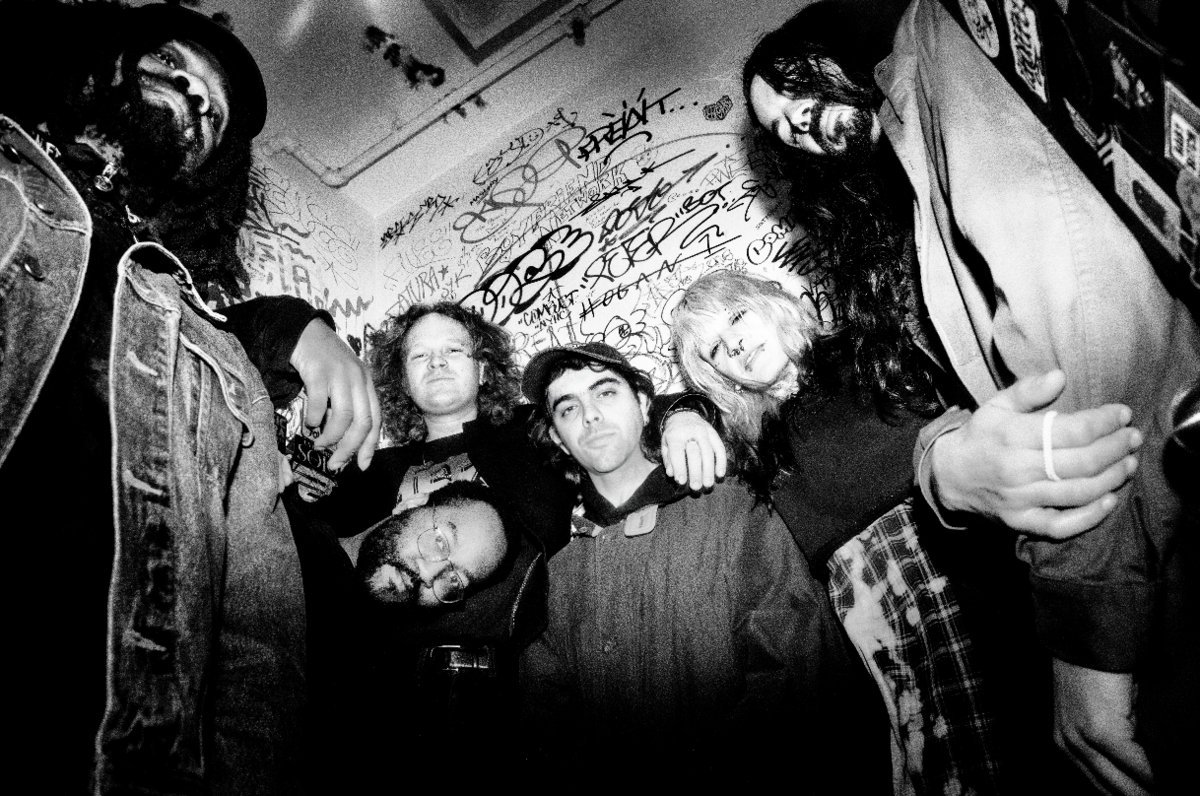
Nu Jazz consists of Dan Orlowski (vocals), Ryan Easter (trumpet), Ben Shirken (electronics, modular synth), Adam Turay (guitar), Kevin Eichenberger (bass) and John Bemis (drums), six very active musicians on the NYC scene. Their backgrounds include hardcore, thrash metal, jazz, ambient, and folk, but on Un Jazz, the goal seems to be a new synthesis of these elements, to distill these influences into something entirely new. Their name may suggest that this is ultimately a jazz band – and partially that’s true – but Nu Jazz are much more; they are noise, they are hardcore, they are electronic, they are progressive rock – you fucking name it. But above all, their music is like the unspoken voice of the Metropolis, it feels like it’s made by the silent screams of millions. That feeling lies condensed under the extremely layered instrumentation and the auto-tuned vocoder screams of Orlowski as they move constantly between anger and some sort of fragility.
While some tracks on the album sound more structured and others are fully improvised, one thing remains the same throughout the 56 minutes of Un Jazz: it’s the sense of urgency that lurks within the songs, this certainty that the music is exclusively focused on the political, social, and artistic challenges of the here and now. Fortunately, all these ‘metaphysics’ around Un Jazz don’t interfere with how spectacular the music can be: there’s great musicianship all around, but I think the biggest delight for listeners lies in the transitions and the mood swings between the ten compositions. From the amorphous, slow-burning free-noise of “Return of the Rant” to the deep groove of “In My City”, the opening tracks do just enough to showcase this.
The rhythm section is responsible for most of the album’s energy and motion, while the rest of the players add colour and expression in quite unpredictable ways, with my favourite being the Adrian Belew-like guitar tones of Turay that bring to mind the King Crimson ‘80s era. Tracks like “369” and “Rearview” carry this idea of fluidity and transformation, as they somehow shift from heavy prog to free-jazz parts – or the other way around. My personal favourite moments, though, are when things actually settle down a bit: the melodic grooviness of “Who Do You Work For”, the futuristic funk of “In My City”, even the exceptional atmospherics of Eichenberger’s bass solo on “Vaporization”, all add smoothness and simplicity to an otherwise complex record.
If Un Jazz lacks something, it would be memorability. Even after multiple listens, it still feels like a labyrinth of riffs, rhythms, and different parts, being clearly a work that doesn’t care to be polished. On the other hand, that’s exactly its charm: if you keep exploring it, you will find that it expands sonically in every direction; it’s unwilling to behave or settle but remains rather rebellious and untamed. While it bears some similarities to other NYC post-genre bands like YHWH Nailgun or Beings, in the end it has a very personal attitude, one that’s equally angry and sophisticated. And as the album finishes with “Civil War”, those King Crimson-meets-post-hardcore-aesthetics will leave a bitter taste in your mouth: that we ought to act more.
Un Jazz is a fascinating album that left me thinking about the evolution of fusion music. Back in the ‘70s, fusion was often synonymous with escapism and its technicality was used as a bridge that led the listener towards magic and imagination. Bands like Nu Jazz show us that today’s jazz fusion can be raw, political, and urgent. In these turbulent times, does escapism feel more like a luxury? Regardless of the answer, music that is sophisticated and carries a genuine street attitude with a rebellious spirit is always an unmatched combo. And this is exactly what Nu Jazz deliver with this deliciously rude album.