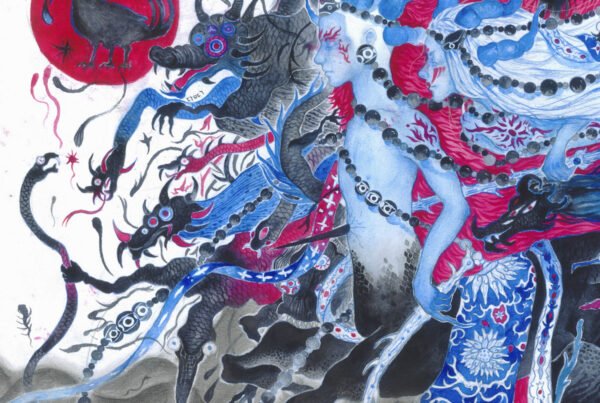
Composers Kali Malone and Drew McDowall experiment and dwell in tone and timbre on their full-length collaboration, Magnetism.
Release date: November 7, 2025 | Ideologic Organ | Kali Malone Facebook | Instagram | Bandcamp | Drew McDowall Bandcamp
People listen to music in different ways; some music requires it. People listen for lyrics, beats, riffs, but sometimes, tone is the highlight. One of the biggest appeals to me when it comes to ambient, drone, dungeon synth, and modern classical music is not just notes and melody, but how the sound truly sounds, or, in other words, the timbre, the perceived sound made by an instrument. Timbre can be the way something is plucked or hit, the strength or speed of a note, effects or harmonization, room acoustics, etc. Understanding that sound is motion, waves that come in an endless combination of shapes and frequencies pulsing through the air, and that hundreds of external forces can modify those soundwaves starts to make an impact, but whether the sound is novel or familiar, it impacts your thinking as well, perhaps triggering memories or shifting your focus. Tone and timbre can be deeply impactful. I can understand guitar pedal nerds’ obsessiveness.
Two artists who have spent their careers considering tone and timbre are Kali Malone, an impressive organist and modern composer whose work is frequently in my favorite albums of any given year, and composer/musician Drew McDowall, a member of the legendary experimental/industrial/ambient group Coil (as well as Psychic TV) and solo artist who has been experimenting with sound for nearly fifty years. Malone and McDowall have been friends and collaborators for a while, but their new album, Magnetism, is their first full-length collaboration. It was composed and recorded rather suddenly after the two met at McDowall’s studio. These five tracks are recorded takes as the duo set limitations on their creative process and allowed their creative voices to sing through Karplus-Strong synthesis (a kind of stringed instrument synthesis) with distortion effects.
The result is stunning. Organ-like tones open the album on “Nothing Here Is Lost” and you can feel the soundwaves as they slowly fluctuate and harmonize. It is like listening to a kaleidoscope that is being very delicately turned. Patterns, or memories of patterns, emerge over the composition’s seven minutes. The sound is simultaneously soothing and cautiously eerie thanks to its key. This serene track is only a piece of Magnetism‘s framework, however. The beginning of “The Secret Of Magnetism” may be soft-sounding plucks, but soon, increasingly massive waves of melodic distortion envelop the mix, at times building to a harshness that rivals Sunn O))) (whose Stephen O’Malley owns the label Ideologic Organ, through which Magnetism is released) or harsh noise wall music, yet it remains accessible as the repetition of the gentle plucking melody acts as a looped rhythm and bass section, rotating in a calming fashion. “Withdrawn Into The Source” lingers in these fields of distortion, though less harsh, they deliberately unfold behind distorted bell and organ sounds, like a funeral procession in a 16-bit cathedral before a long fadeout lets those dulcet frequencies shimmer through once more.
Magnetism‘s advanced single, “The Sound In My Mind” sounds absolutely massive, layers of tones harmonically build on each other while pink noise and gently distorted melodies haunt the ether, each note shivering like the nervous dance of fireflies in a cooling autumn breeze. As the song morphs from one spectral form to the next, it climaxes and drops out its melodies into a mesmerizing closing drone that breathes as deep as a blue whale. Kali Malone and Drew McDowall chose an absolute stunner for fans to preview Magnetism, however the 11-minute closing track, “A Sound That Is Alive” is the crown jewel, merging all of the sonic tricks from the previous four tracks into an immense journey into deeper psychic and sonic realms, frequently surprising and satisfyingly saturating like nothing else I have heard this year. It is dense like a weighted blanket and subtle like a chamomile tea.
Magnetism may have been born out of spontaneity, but for aural architects as masterful as Kali Malone and Drew McDowall, it may as well be a fresco painting painstakingly detailed with subtle nuances and textures, every stroke as arresting as the whole. This music flows through you. I have never done sound therapy, but I would like to think that music as gorgeous and transcendent as this would be ideal. If not, this album at high volume in a candlelit room would certainly be a healing experience.