

‘There’s something decadent and self-absorbed about their version of evil—something more concerned with indulgence, sensuality, and excess than simply conjuring images of fires in the woods and hooded figures performing ceremonies.‘
-Jake Walters
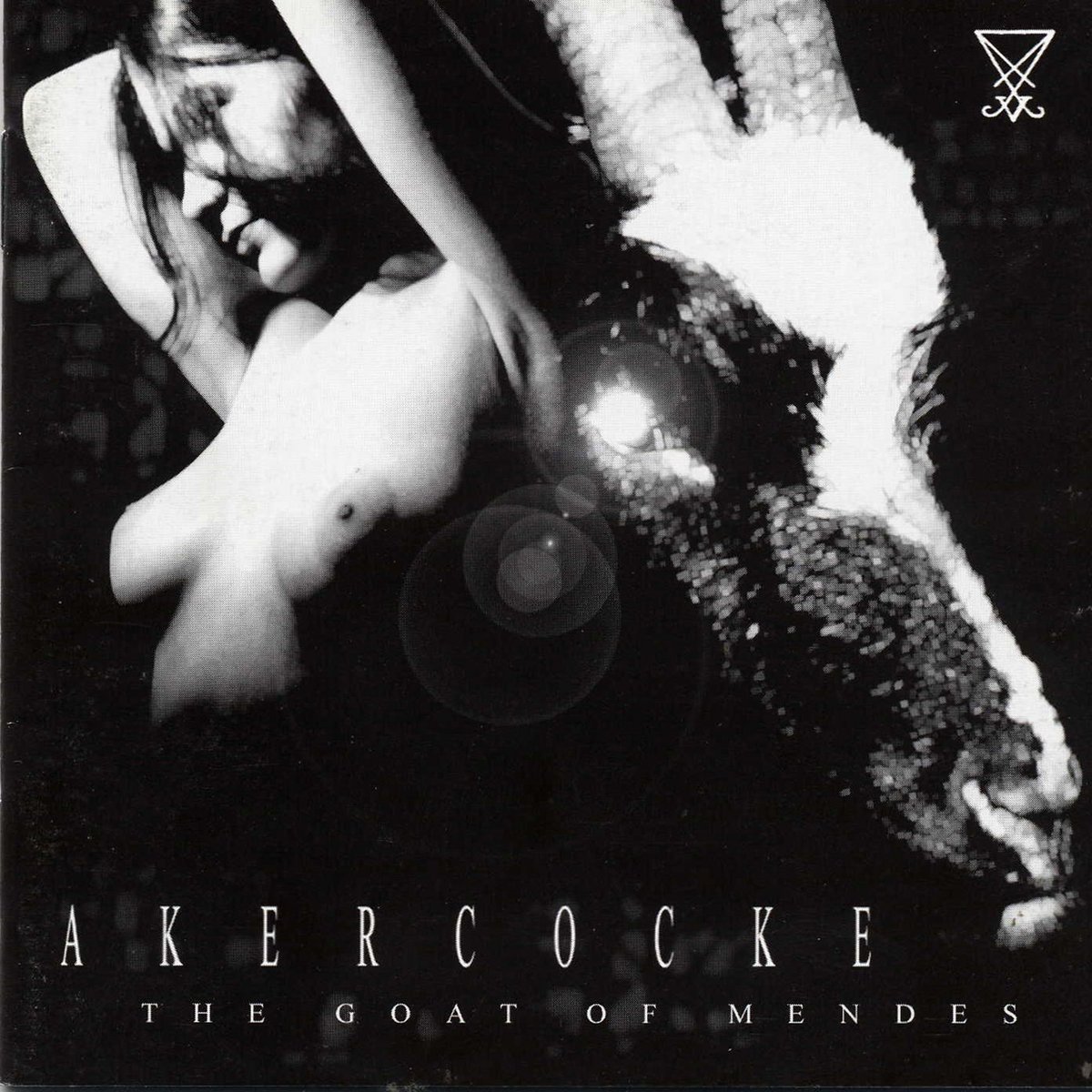
Release date: September 11, 2001 | Peaceville | Facebook | Instagram
Metal has always dealt in various shades of occult or outright satanic imagery; even the subversion of the trope in, let’s say, overtly Christian metal always feels like a direct reaction to the prevalence of Luciferian themes within the subculture. One of the most delightfully indulgent band in terms of ‘do what thou wilt’-brand Satanism has to be Akercocke, whose sophomore release The Goat of Mendes turns 25 years old next week.
Iain Ferguson
‘All the best bands are affiliated with Satan’
– Bart Simpson
Old Scratch and metal have a long, fruitful relationship together, that much can not be denied. Ever since Black Sabbath debuted on those dire tritones, Satan has been a regular fixture in heavy music, showing up in discographies ranging from the filthy rebellion of Venom to the metaphysical philosophical musings of Deathspell Omega (who I’m sure plenty of us loved before we found out about the vocalist). It’s funny in that regard that 25 years ago a band like Akercocke, who was actually earnest in their Satanic views, was something fresh and novel.
Actually, when it comes down to it, Akercocke is still something fresh and novel. Sharply dressed, well-versed in their carnal, theistic Satanic approach while never feeling too self-serious, and peddling a complex blend of heavily progressive black and death metal, there still aren’t a lot of bands out there that sound like Akercocke. On a personal level, as someone who found the pleasures of metal by way of a passion for prog rock, Akercocke is responsible for some of my favorite music in the genre. The Goat of Mendes probably isn’t my favorite album in their canon, but it’s definitely where they fully came into their own as a band, and I’ll be damned (maybe literally this time?) if I wouldn’t still call it a thoroughly phenomenal album.
Within the first two chords of the album opener “Of Menstrual Blood and Semen”, it has to be noted that The Goat of Mendes sounds evil (alongside being utterly NSFW between the blatantly sexual themes and samples). Akercocke has never had a problem crafting an atmosphere of genuine darkness, but something about the way they wrote The Goat of Mendes is particularly malevolent within their discography. Maybe it’s the thinner, more ragged production, or how the black metal quotient is a bit higher here than, say, Choronzon or (my own band favorite and a personal top 5 death metal album) Words That Go Unspoken, Deeds That Go Undone, or the absolutely deranged layering of Jason Mendonça’s vocals, but it just works.
But Akercocke has never been just a generic musical journey through hell. Moving beyond the opener, “A Skin for Dancing In” ups the complexity with queasy synth lines, more clean guitars, and dramatic clean singing, bolstering its sheer force, guttural grunts, and off-kilter rhythms. The addition of a saz solo deeper into the track (they also always had a knack for Eastern scales) just ups the progginess on display, and further cements how unique the band still sounds.
Much of The Goat of Mendes falls on either side of that balance. “Horns of Baphomet” kicks off at an utterly doomy pace before kicking up the tempo, while closing “Ceremony of Nine Angles” pulls in some guest female vocals and gives Mendonça some opportunities to give some malevolent spoken word across its labyrinthine passages. Meanwhile, “Masks of God” and “The Serpent” are more direct scorchers that are absolutely relentless, while still alien and unusual in their progressions. “Infernal Rites”, fittingly, blazes despite the more electronic intro, while “He Is Risen” wastes no time ripping into a shredding solo before a bit of sick thrashing. Pepper in a couple more atmospheric, ambient interlude tracks, and you have yourself one absolute firestorm of progressive black/death metal album.
The musicality across The Goat of Mendes is just plain outstanding. Mendonça and Paul Scanlan prove a phenomenal guitar tandem, delivering riffs and solos by the boatload. It’s not for nothing that I’d still refer to David Gray as one of my favorite drummers in all of metal, and he kicks up an absolute storm across the album. It’s no wonder he’s been tapped as Annal Nathrakh’s live drummer for a few years now. Martin Bonsoir’s keyboard textures are pitch perfect, and Peter Theobalds’ bass is tasteful and nimble any time it cuts through the din of the guitars. It may take a bit of acclimating to The Goat of Mendes’ production if you’re coming from their later work, but even that proves an asset in upping the sheer malevolence The Goat of Mendes has on display.
Akercocke wouldn’t take any time to rest on their laurels after The Goat of Mendes. If anything, the album kicked off a generational run with its two successors and the slightly patchier but still excellent Antichrist, before falling into relative recording silence, only briefly broken in 2017 by the also marvelous, if conceptually different Renaissance in Extremis though they’ve made mention of working on something new in recent years. It does mitigate their quietness that great splinter bands like Voices and The Antichrist Imperium have expounded on Akercocke’s approach. And in fairness, at least as of 2017, I can personally attest to them being an absolute force of nature on stage. It sure would be a delight to hear more from them soon, though.
With all due respect to their debut The Rape of the Bastard Nazarene (to Hell with subtlety, right?), The Goat of Mendes was that firm foundation that Akercocke built their career out of, and it remains quite a sight to behold in its own right. It’s no wonder why, in a recent interview, David Gray noted that it’s the Akercocke album he’s still proudest of. More raw, more confrontational, and yet no less ambitious and artful, and all coming from guys who wore suits and ties on stage. There aren’t many bands like Akercocke, and even if I don’t reach for them all the time, any revisit reminds me that they are indeed one of my favorite bands in metal. Revisiting The Goat of Mendes only raised my appreciation for the album, and also made me remember how damned much I love their other works. So hail to The Goat of Mendes for delivering 25 years of fucking darkness. And I’m emphasizing both of those words.
Paul Williams
Looking back at 2001, I think it’s fair to say that it was an interesting year for non-cvlt black metal, as more bands added their own spin on what the genre could be outside of the frostbitten variety. We had Dimmu Borgir put on their big boy orchestral pants and release Puritanical Euphoric Misanthropia. Anaal Nathrakh unleashed hell with their debut The Codex Necro, and more importantly (at least in the context of this article), fellow Brits Akercocke turned an innocent, impressionable, and inquisitive dickhead of a teenager (me) into a man with The Goat of Mendes.
Now, I should be clear, I came across Akercocke in print long before I ever got around to listening to them. When I was a fledgling music lover I had a heavy metal encyclopedia (yes – I was that sort of kid) with loads of bands across different genres of metal. Alphabetically, Akercocke would have been one of the first bands that I read about but, most likely what caught my attention was the album cover for The Goat of Mendes which famously features boobs alongside Black Phillip of The Witch fame.
Probably a couple of years later when I eventually listened to Akercocke’s sophomore album, The Goat of Mendes, I remember quite vividly a frisson of excitement, or maybe even fear, running through me as the opening guitar riff to “Of Menstrual Blood and Semen” kicked off. There is something about that buzzing distorted tone that, even now, gets my stomach turning with anxiety. All this quickly gave way to rampaging and erratic drum fills, topped off with a chaotic mix of incomprehensible gutturals and screeches, with the few understandable words being Lucifer or Satan. To a kid who probably was well accustomed to the Satanic imagery in metal, Akercocke seemed to not just kick it up a notch, but to come across as genuine mouth pieces of the devil.
I can’t think of a band that has ever had the ability to sound as wonderfully evil and imposing in the same way as Akercocke. The use of, what I can only describe as, the Evil Dead-demon-voice effect on the vocals at the beginning of “A Skin for Dancing In” talks to the horror enthusiast in me. Similarly their use of different drone and ambient elements to set tone outside of blasting and screaming, like on “Betwixt Iniquitatis and Prostigiators”, offers reprieve without sacrificing atmosphere.
It’s on the verge of kitsch how ‘evil’ it is but sometimes it takes ignoring the over the topness for the sake of being swept away, like watching a horror movie and allowing yourself to not question how Michael Myers is able to catch up with a sprinting teenager while he goes for a gentle-paced, night time stroll.
But I’ll also use this as a moment to take off the rose-tinted glasses and admit that this revisit has made me realise that the second half of this album is a drag. The run from “Of Menstrual Blood and Semen” through to “Masks of God” is A-grade melty-face, blasphemous good-good. The second half is more of the same but with fewer memorable riffs. There’s more of a feeling that demons are trying to get you to go to sleep rather than scoop your own eyes out with a spoon.
I’m also on the fence about how well this album has aged. Akercocke’s sexy-vampire-businessmen schtick and fascination with Satan, nun-fuckery, and cum doesn’t feel tired in the context of this album and when it came out, but when looking at the wider world of metal and extreme music in 2026, it’s not exactly fresh anymore. And I guess I’m fine with this really, we can’t expect everything that we loved in the early 2000s to age well *looks disappointedly at a dusty pile of Kevin Smith movies*.
Would I recommend this as the first Akercocke album to check out? Probably not. If I wanted to show someone how good Akercocke ended up being, I’d point them to the range, production, and songwriting that they showed off with Words That Go Unspoken, Deeds That Go Undone and Choronzon. Those are easily their best albums, and the ones where they really came into their progressive black metal phase that they were only dabbling in across their sophomore album.
But that’s not to say The Goat of Mendes isn’t absolutely special. Even after all these years, it has a soft spot in my heart. There is a vibe on this album that is so inherently evil, yet dripping in elegance and confidence, bordering on sexiness; traits that we are rare to find in a style of music that relies on machismo and Satanic posturing. Despite very obvious schtick of the band, it was carried out with an earnestness that, for entertainment’s sake, made it easy to slip into a world where black masses were more than a group of people playing dress-up but a true means of conjuring the Devil.
Jake Walters
Akercocke have always struck me as a band that understands how to make Satanism feel less like pagan ritual and more like outright hedonism. There’s something decadent and self-absorbed about their version of evil—something more concerned with indulgence, sensuality, and excess than simply conjuring images of fires in the woods and hooded figures performing ceremonies. On The Goat of Mendes, that distinction becomes one of the album’s greatest strengths. It manages to feel primal and composed, filthy and sophisticated, sensual and genuinely hostile, often all at the same time.
The album establishes that tension almost immediately. Between the explicit, bawdy title of the opener and the cover artwork, it would be easy to assume you know exactly what kind of record you’re walking into. Everything points toward a very particular kind of occult extreme metal. But The Goat of Mendes quickly proves that it has considerably more on its mind.
“A Skin for Dancing In” is one of the first places where that becomes obvious. For one thing, it remains one of the coolest song titles on the album—and frankly one of the better metal song titles I can think of. The song itself is moody and occasionally gothic, with vocal hooks that can be surprisingly catchy. At the same time, the guitar tone is raspy, abrasive, and almost deliberately ugly. That friction works beautifully. There’s something unusually stylish about the vocal lines and atmosphere, while the instrumentation underneath them continues scraping away at that elegance.
And then there are the horns—the kind that sit on Satan’s head and the kind made of brass that go toot toot on metal records.
Brass instrumentation has had a strange and storied relationship with extreme metal. Some bands embrace it completely; others seem to regard it as something fundamentally incompatible with the genre. Akercocke, however, never seem particularly afraid of introducing it into their sound. When horns appear here, they aren’t simply decorative. They give the music a stronger sense of place and, at times, an almost Art Deco decadence. They expand the album’s vocabulary without making it feel as though the band has wandered away from what they are.
That makes “Horns of Baphomet” an especially fitting example of what the record does so well. The guitars are gritty, the harsh vocals are vicious, and much of the performance feels raw and physically aggressive. But surrounding that are vocal passages that are softer, melodic, and almost sensual. Rather than undermining the extremity of the song, those moments make it stranger. One side makes the other feel more pronounced.
And I think that contrast is ultimately the best thing The Goat of Mendes has going for it. It takes ideas that seem like they should be incompatible and finds ways to make them coexist. Sometimes the result is a smoothie; sometimes it’s a parfait. Sometimes everything gets blended together until you can barely tell where one ingredient ends and another begins, while elsewhere the layers remain completely distinct. You can hear exactly where the gothic atmosphere stops and the face-ripping death metal begins.
That unpredictability matters in extreme metal, where there can be a tendency to measure intensity through accumulation: faster blast beats, more aggressive riffs, harsher vocals, crunchier guitars. Akercocke can absolutely deliver that kind of violence, but The Goat of Mendes understands that extremity becomes more effective when it has something to push against. The melodic passages make the brutality feel more brutal. The sensuality makes the ugliness feel uglier. The moments of elegance make the record’s eruptions feel genuinely dangerous.