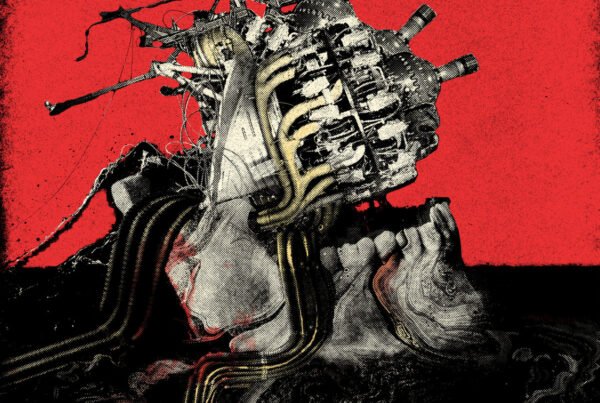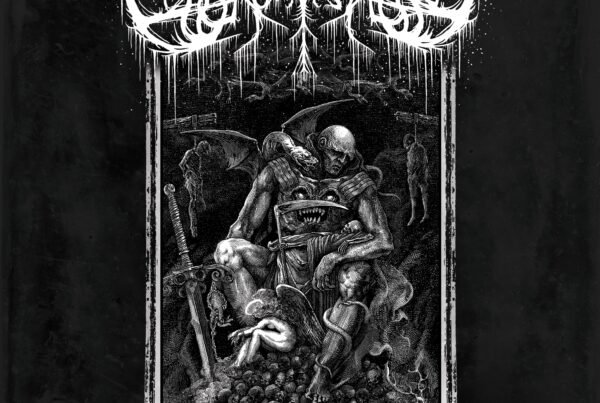



On album #7, Eidola continue their run of hyperactive, genre-hopping tastelessness.
Release date: November 20, 2026 | 3Dot Recordings | Instagram | Facebook
I was dreading writing this review. It’s rare that I speak at length about something I don’t like, and it’s even rarer that we here at Everything Is Noise would go out of our way to do so (a recent exception would be the new Green Lung album but Colleen‘s review of it was hilarious). However, after challenging myself to listen something outside my usual wheelhouse, I happened upon current ‘sensitive’ p̶o̶p̶ ̶g̶r̶o̶u̶p̶ metalcore band Eidola‘s seventh album, The Will to Power. The reaping isn’t the hard part; the sowing is excruciating.
The scourge of soulless, R&B-flecked djent has infected the airwaves lately in the form of groups like Sleep Token, Bad Omens, and so on – bands that want to write pop and metal at the same time, never picking a lane and therefore always ending up in the middle of the road, hurtling headlong into the traffic jam I colloquially call ‘co-worker metal’. This can be traced back to what Bring Me the Horizon began doing in the early 2010s starting with Sempiternal, which was basically imitating Linkin Park‘s classic sound with a bit more technical finesse and bite. But where BMTH‘s pivot came across as genuine affection for a formative musical influence, these other artists seem more like they simply want to ride the coattails of previous success stories to the Download Fest stage of their dreams. Before TikTok became the way people found new music in the form of 30-second clips, there was well and truly an underappreciated purity to executing one style effectively, instead of four styles underwhelmingly. The worst part is that it’s not impossible to make this work: Baltimore’s Nightlife combine funk, soul, and djenty guitars in a way that’s catchy, charismatic, and above all likeable. Maybe it’s too much to ask for every crossover artist to operate with such tastefulness.
On their prior six albums, Eidola were guilty of this refusal to settle on a distinct sound; on The Will to Power, it curdles spectacularly. This album is terrible in a fascinating way: the quantized, cleaned-up technicality is on full display, the touched-up singing is as corny and melodramatic as ever, and the tough-guy posturing sits alongside it in a way that sticks out like a thumb that just got slammed in a car door. Take the single “Damballah”, which starts out in a stodgy, sub-Periphery stomp before an embarrassing rap verse cuts in: ‘I am a concave echo at the end of a drone/I am a lone lost beggar at the foot of the throne/I am a creature, I am a blasphemist‘. It needs to be heard to be believed, but trust me, you don’t want to hear it. This in turn gives way to sub-Sleep Token whining, the unctuous chorus melody and stacked harmonies sounding lotion-smooth and completely artificial. A song about a Haitian Voodoo deity that created the cosmos and takes the form of a snake should be way better than this.
Bad taste abounds elsewhere in the tracklist: “Purity Ladder” has Dead Letter Circus-lite pulsing electronics that add nothing to the alternatingly (and annoyingly) high-pitched tremolo and math rock guitar screeching, “Arethusa” pairs U2-aping delay-soaked guitars with bro-down screaming and a truly awful squeaky-clean falsetto chorus, and “Nothing Ever Happens” combines all of the aforementioned qualities into a hysterically shitty mélange of Polyphia-style, hypermelodic guitars with obnoxious synths and showoffy vocal riff runs that draw more attention to the obvious pitch-correction being used than anything else. “Axiology” opens with a vaguely country-ish vocal melody before dropping into Eidola‘s bread-and-butter (namely, if Coheed and Cambria dialed up the technicality and forgot how to write memorable songs) complete with a directionless, space-holding ‘da da da’ bridge and syncopated final chorus rhythm that would be impressive if not for the forgettable pop chorus that dominates it. It’s kind of incredible how every time Eidola attempt some crunching, metal-leaning momentum, they feel the need to undercut it with flavorless pop melodicism: “Leviathan” threatens to actually kick ass in the way Architects used to before grinding to a halt with yet another instance of weak singing and a chorus that leaves absolutely zero impression.
Some slight reprieve comes at the end of the album. “Hyperion Hymn” has some dynamic songwriting, opening with clean guitar and soft singing that actually builds into the beat and comes back before the final chorus – still not great, but it’s something different. And “Niflheimr”, while still bearing all the hallmarks of the insufferable tracks that preceded it, uses its five-and-a-half-minute runtime to explore some worthwhile ideas: the dissonant guitar run around the halfway point and squalls of noise that accompany it would sound sick if the production didn’t neuter it right out of the gate, and the saxophone solo that enters afterwards at least provides a sonic switch-up that’s easy on the ears before the screaming and djenting take the song, and album, out. This ending could have been a LOT worse, so kudos to Eidola for having the good sense to save its best ideas (and arguably its only worthy ones) for last.
Perhaps I’m just not the target audience for this type of music. I was fooled by the busyness and intensity of Dance Gavin Dance‘s early work when I was a teenager into thinking that if a post-hardcore group is hyper enough, that makes it worth listening to even when its generic, ‘angelic’ clean singing and lack of memorability leave a lot to be desired. Not every band can be as influential or successful as Circa Survive or (despite their former manager’s best efforts) Sleep Token, and none of them should try to, either: in the former’s case it took a crazy streak to make it work, in the latter’s it was a time-and-place explosion of popularity. These are things that Eidola prove they just don’t have on The Will to Power. The music is uninteresting despite its fast pace and technical nature, the writing too obvious in its desire to appeal to absolutely everyone who might hear it, and consequently it sounds simultaneously like metal without courage and pop without conviction. Let the pop/R&B artists do their thing, and let the -core groups do theirs; you can’t have it both ways, guys. Next time around, just pick one – and let a little looseness come in through the cracks, I promise you’ll sound so much better for it.