


‘I hope one day I can look at death and understand it as nothing but a step’
I often find myself in the headspace of where I am preemptively mourning the loss of those around me despite them still walking this mortal plane; Counterparts’ “A Eulogy For Those Still Here” couldn’t be more appropriately titled and lyrically, it is something I connect deeply with. As you would correctly assume, I’m a sucker for existential music as it feeds right into this mindset of perpetual grief, anticipatory or not. Although it took a hot minute, it was through music that I finally came around to understanding and appreciating the inescapable, bittersweet beauty (if you could even call it that) that is associated with loss. It pushes me to better appreciate the lives of those around me by loving them even harder while I still can, even if it means the eventual grief will be all the more painful further down the road.
Music under this existential umbrella provides a much-needed reality check when it feels like you’re going through the motions and unknowingly taking things for granted at times. Whilst this difficult and emotionally dense subject matter is captured across nearly every music genre/subgenre you can think of, I find that instrumental & atmospheric music takes it to another level. The slow-burn nature of said music is capable of portraying the unspoken mourning that accompanies one each waking day behind closed doors. The way in which this mourning whittles away at your soul isn’t really able to be ‘recreated’ in other musical contexts that are more direct and meant to be immediately gratifying and retell stories of ‘pivotal’ moments as opposed to the repetitive, day-to-day battles.
I find that ambient and some post rock do exactly that, representing the single tear shed over a now-lonely cup of coffee (or the one-thousandth cup of lonely coffee years later), or even the fixation on the deafening silence in a household or space that was once filled with noise, youth, and joy. That silence is just a reminder of what once was and will never be again, and it hits you in places and at times that you’d least expect it. All that being said, the expansive, long-form nature that is attributed with ambient/post rock fosters this meditative environment uniquely suited to allowing the listener to embrace and process those complex, melancholic emotions (for better or worse).
This is exactly the type of thing that I live for, as it feels like a long, warm hug that I unknowingly need. Like I said earlier on, this amorphous style of music is powerfully grounding in how it keeps me in tune with my own emotions and forces me to realize what truly is important in this short life. Various albums immediately come to mind that scratch this itch: Departure Songs either by We Lost the Sea or Hammock, Autumn Creatures‘ Funeral Garden, and Vines’ I’ll be here. Those are just the few that immediately come to mind and that I’ve been glued to lately. There are many, many more that exist of course, even outside of this musical niche I’ve been zooming in on.
Anyways, that list goes on and on. I’m always on the hunt for this type of music and one day I came across an Irish group who go by Overhead, The Albatross. This band at the time had just released their most recent album, I Leave You This, and this was my introduction to them. It didn’t take long to realize that they are one of the least conventional post rock-post rock bands out there, which would unsurprisingly make them one of the more memorable ones. Not only does their sound fall into that tight niche of introspective ambient/post rock, but the subject matter gracefully embraces the human condition. First, I got some insight into the band from their very own Luke Daly, and here is what he had to say about their inception:
‘When we got together we were all at university. Most of the guys had been in bands before and were eager to experiment with new sounds. A lot of us had been friends for years when we got together, some of us had never met, which was interesting. A couple of us had stumbled across post-rock a few years earlier and had become obsessed by bands like Explosions in the Sky and 65daysofstatic, alongside neo-classical composers like Jóhann Jóhannsson, these new sounds had completely captured us. The rich layers of cinematic guitars or strings was a sound we didn’t realise we were looking for. Growing up, we’d each been shaped by a wildly different diet of music from Pink Floyd, Led Zeppelin, Fats Waller, Bob Dylan, The Prodigy, Radiohead, Incubus, and Irish artists like David Kitt and Damien Dempsey. So, by the time we actually formed as a band, there was a massive melting pot of influences to draw from.’
Overhead, The Albatross as a band name is very specific, but oddly enough it was something that sounded vaguely familiar to me. I had to dust some cobwebs in order to make the connection that it was a reference to Pink Floyd, and based on what Luke mentioned above, it checked out indeed.
‘I remember the first time I watched the film, Pink Floyd Live at Pompeii, it literally changed my life. The location, the sound, the control of the effects, the editing, it was all so inspiring. I think Pink Floyd had a powerful effect on all of us at different points growing up, so when the name was suggested, it felt immediately fitting. It’s also a remarkable line from Samuel Coleridge‘s poem, The Rime of the Ancient Mariner.’
For a debut, Learning To Growl is immensely impressive and can easily hold its weight alongside the heavy hitters of the genre, such as the artists that Luke directly referenced as inspirations to their music. This album is rich with so many dynamic textures, from twinkling piano and fluttering electronic effects, to sorrowful orchestrations and cheerful brass. All of this is delicately layered over hypnotic cymbal work (and percussion in general), gently layered guitar melodies and arpeggios, and thunderous bass. It’s hard to single out a single song when all of them equally capture what I just described, yet they’re their own completely separate sonic journey for you to experience. Just let it play and take you away.
With this first album, it was immediately clear their song writing chops were bar none from the start, which would naturally continue on their follow up, I Leave You This. Given that these two albums have so much instrumental depth beyond what you’d typically expect from any post rock outfit, you’d wonder how it all comes together from both a compositional perspective, but also a mixing/production standpoint. Luke sheds some wisdom on the matter:
‘The songwriting process has evolved enormously since the first album, Learning to Growl. There’s a lot more intention behind what we do now. We’re not just writing songs that sound good, though that never stops being important, we’re trying to explore our own lives and emotions, to actually say something. We’ve found a new space as a band, one where we allow ourselves to be more vulnerable and open, and honestly that’s been both terrifying and exciting in equal measure. The process itself is a long, sometimes grueling road. We deconstruct songs constantly, tear them apart and rebuild them into something we couldn’t have imagined at the start. You’d be genuinely shocked to hear where some of these songs began and where they finally ended up. But when it all clicks, when the thing you were reaching for suddenly comes together, that’s a high that nothing else can really touch.
‘We are very particular about where the extra sounds come in and out, it’s all a constant balancing act. One of the most integral parts of our music are the string sections, which we pour a lot of care into writing and love hearing come to life. We’ve also transitioned into a slightly more electronic sound, which might be divisive for some people and has perhaps pushed us a little further toward the outer edges of the post-rock genre. But we write what we want to hear and it’s an honor when it resonates with other people.’
Speaking of the shift towards electronics on their follow-up record, we find ourselves with I Leave You This, which I personally found to be even more soul crushing, yet just as beautifully hopeful. The second track in particular, “Your Last Breath”, left me an inconsolable mess, with its linear progression taking you across weeping orchestrations, wailing saxophones, and glimmering electronics all interwoven over a tight post rock groove. This song builds and builds into a monumentally poetic climax that is one for the books with how gut-wrenchingly vulnerable it is about the very last look one would ever have with someone they could never imagine life without. This track is one that further cemented the idea into my head that love and loss are synonymous with one another; only now do I finally see what love truly is. Luke expanded on “Your Last Breath” and its juxtaposition with the following track, “Welcome Home”:
‘I Leave You This as a whole is about the cycle of life from birth to death. I think as you get older, you begin to appreciate life more deeply, but you also come to realise that even the happiest, most euphoric moments carry a tinge of melancholy. That bittersweet quality is woven into everything we do.
‘John Daly, who this album is dedicated to, was my father who passed away during the production of the album. “Your Last Breath” is my eulogy to him. Over the last few years, we’ve all been navigating loss and new life, and we fed all of that into this record. If you listen to “Welcome Home”, which comes immediately after “Your Last Breath” on the album, it opens with the sound of the first time Stevie, our bassist, heard his son’s heartbeat. I think those two disparate moments capture the nuanced themes of the album better than anything else could. Paul (whom the track “Paul Lynch” is in reference and dedicated to) was a great friend and a wonderful man, a gentle giant who was endlessly positive and supportive of us, both of our music and our lives.’
Wow. “Your Last Breath” already hit so hard on an emotional level, but understanding exactly what fueled this powerful song is bittersweet indeed. After Luke mentioned that, I immediately went to “Welcome Home” and was stunned by how I never noticed that hidden detail of those first swooshing heartbeats captured via ultrasound at the beginning of the song, especially after having gone through that experience myself as a father. “Paul Lynch” is the other standout and favorite track of mine (not to imply the unmentioned tracks don’t stand out, the emotional weight of the climaxes of these songs is just unmatched). The way the slow build up culminates into this incredible electronic-tinged explosion following the brief heartfelt spoken word passage never fails to send chills up my spine.
‘Farewell to you. Farewell my friend. Farewell to you, we’ll meet again.’
It is impossible to not be moved by this album, especially “Your Last Breath” and “Paul Lynch”; if you didn’t feel anything, you need to check your pulse because you’re just a walking bag of meat and electrolytes at this point. I inquired with Luke about what he is distracting and inspiring himself with given the current state of the world. It is more important than ever to indulge in your passions and continue to be inspired by the good that surrounds us, even if it is small in magnitude compared to the atrocities currently unfolding.
‘I can’t speak for the rest of the band, but I know I’m constantly inspired by everything I consume. I watched Thelma and Louise last night and found myself struck by how Ridley Scott, known at the time for his sci-fi, fantasies or dystopian nightmares, managed to tackle that topic so well and still add his flair. There was something about 90s filmmaking that felt genuinely fearless, a rawness and ambition that you don’t always find in the craft today, Thelma and Louise sits right at the heart of that era. A few evenings before that it was Wim Wenders‘ Perfect Days, a film that finds such quiet beauty in the subtle details of life. On the music side, Raye‘s new album is a remarkable piece of work, as is the new VLMV album, the latest Boards of Canada single, and the Boys Noize and Nine Inch Nails mashup that has been living rent-free in my head. I think the main thing is to keep feeding the unconscious mind as you never know where any of it might eventually surface.’
I could go on and on about the many details to be uncovered in Overhead, The Albatross’ mystical amalgamation of sounds (apparently, there are even more details that I have yet to properly decipher myself) but I’ve gone on long enough. Seriously though, this band is truly something special and it is absolutely CRIMINAL that they aren’t as big as the legendary Pink Floyd themselves, especially with the not-so-subtle nod to them in the band name. But so long as the bourgeoisie selfishly pull the strings behind each and every facet of modern society, including music, sadly nothing will ever be just.
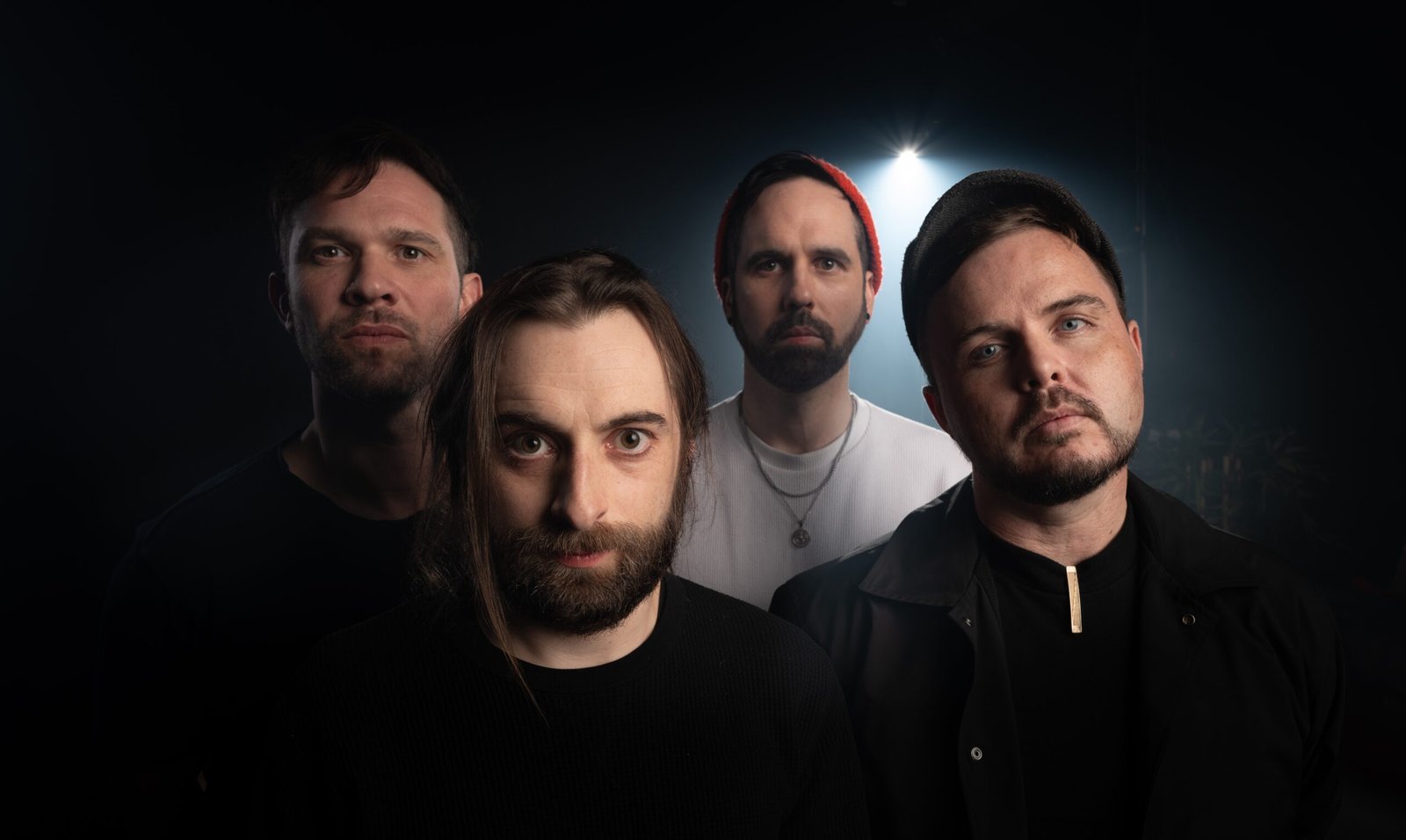
Overhead, The Albatross is:
Luke Daly – vocals, guitar
Vinny Casey – guitar
Stevie Darragh – bass, guitar
David Morys Prendergast – piano, synths, vocals
As I wrap this up and wipe away my tears after re-re-re-rewatching all these evocative music videos, I implore you to check out and support Overhead, The Albatross if they’re novel to you. At the time of writing this, they don’t even have 10k views on the music video for “Your Last Breath” and not only was the music as perfect as can be, the cinematography was equally as stellar and moving. The artistic vision and ability that this group of individuals possess is not something I can say applies to most musical artists out there, no matter how successful they may be, full stop. Whilst they fully deserve every single unit of currency sent their way, at the very least you could click some buttons on your phone or computer to help support them. Swing by their socials (Facebook, Instagram, Bandcamp) and do me this favor, please.
‘But there’s a beauty in the knowledge that we are together in this mess; In birth, and in life, to our death and our last breath‘