

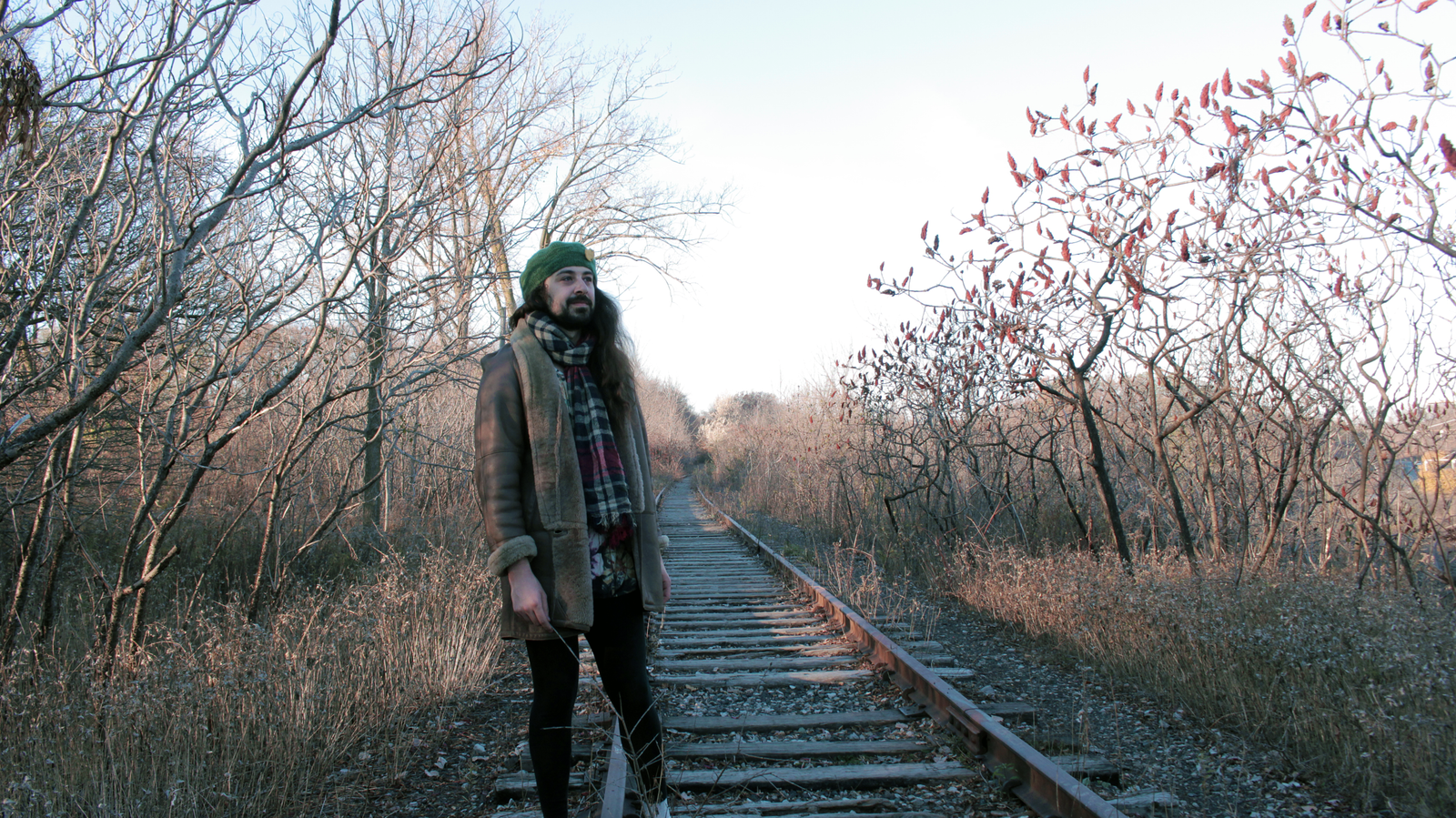
I became acquainted with Toronto native Kelly Masil-Mitro through their work with Magna Vita, a power-pop group that released a few bangers on an EP back when I was working at The Hard Times. Masil-Mitro and I are also fans of a few similar podcasts, so I gave them a follow and watched the development of their experimental bedroom project, Cannibal Mukbang (no relation to the 2023 film), in real time.
Cannibal Mukbang operates in a unique space, combining elements of trip-hop, sound collage, bedroom pop, and even folk music into brutally earnest, unrefined declarations of isolation and loneliness in a digitally-defined world.
Tracks like “Rain” from their most recent EP begin with a hooky acoustic guitar riff before Masil-Mitro’s vocals croon: ‘You know it feels like one way or another / I am always lettin’ you down’. Despite the instrumentation feeling cozy at first, there is something cheek-chewingly anxious about Cannibal Mukbang‘s confessional lyrics, an underlying tension that seeps through even their most stripped-down tracks.
The field recording side of things takes center stage in much of Masil-Mitro’s production, as seen in this video on their social media that blew my mind:
This sort of creative production based around everyday objects reminds me of Kathryn Mohr‘s Carve, which incorporates sounds recorded on a remote ranch. While Cannibal Mukbang‘s music occupies a much different genre than Mohr’s, the impulse is the same–to take something as average as a coin spinning and morph it into a new form entirely.
Prior to the recent release of Cannibal Mukbang‘s sophomore EP, titled Bruises, they published a video for “A Life That Isn’t Yours”, a piece dripping in visual and auditory nostalgia that explores many of the emotional themes within their work. The track could pass for a piece off the Perfect Dark OST or a Moby B-side; crunchy ’90s synths atop groovy programmed drums that evoke a sense of danger and dread.
Masil-Mitro, who hilariously refers to themself as ‘non-binary and non-performing‘ was kind enough to exchange thoughts on their journey to becoming Cannibal Mukbang, their songwriting and production process, and the anxieties that underscore their core artistic expression.
You’re a lifelong musician, right? Can you tell me about your previous projects and experiences? What led you to start this bedroom project?
I had been playing bass since age nine, but outside of that I didn’t spend any of my youth playing in bands. By the time I had hit high school, I was more interested in filmmaking, and eventually that’s what I went to university for.
But in university I also started a fascination with record collecting and underground music. It was only after I graduated that I joined my first band, Magna Vita, after reconnecting with our lead singer Davey White. That became my first experience of playing shows, making music videos, and even doing a small European tour in 2025.
My taste has always been more eclectic, and I had been building up a catalogue of my own recordings that wouldn’t fit in with Magna Vita’s style.
None of the films I was working on ever seemed to call upon me to get weird with it, and I started to get more inspired by the music I’d listen to in my downtime. I started to get upset that each idea in filmmaking had to go through at least 20 or so people to come to fruition, and that’s when I bought Ableton and started making music on my own in my room.
One of the things that first drew me to your work was your use of ‘found sounds.’ How did you wind up working in that realm?
That came from my time in film school. I initially got a Zoom field recorder to shoot videos with, but it just became so much fun to just try to get something to make a weird noise and capture it. That became a hobby of mine, and I just started amassing a catalogue of random sounds from all over. I didn’t know what I intended to do with them, why I was saving sounds of me rubbing pool noodles together for a rainy day, but it’s clear it was a catalyst for some type of self-expression.
I remember making music during my online lectures, with some professor talking about Canadian film history on mute in the background as I added flangers and distortion to the sound of a beer can rolling down the sidewalk. I think that’s when Cannibal Mukbang truly began.
The video for “A Life That Isn’t Yours” is so nostalgic. Can you tell me a bit about how your experiences online shaped the vision for this track and video?
My life has been entirely within the era of the internet invading all facets of everyday life. I was a kid in the 2000s when Facebook and the iPhone and YouTube were radically optimistic spoils of technology, and my journey into adulthood feels like those companies have transitioned into cultural monopolies that we all basically agree are poisoning us to a certain extent.
With that video I wanted to present the cold, impersonal language of modern-day tech in aesthetics associated with its past, when it had more of a soul in its visuals. Part of the concept is a sci-fi-ish anxiety I have. If we develop a way for a consciousness to exist inside of a computer under some guise of eternal life, but it’s still just capitalist hell- just an endless stream of content.
I tried to make the video from the perspective of a company trying to pitch that to a consumer. That Frutiger Aero style is what I associate with my happiest memories online; I think that’s how they’d get me.
What’s changed for you between your two EPs, both personally and artistically?
Once I put out New Freaks Under the Old Bedsheets in March, I felt a lot of momentum to do more. I realized it wasn’t some insurmountable goal, and if I concentrated, I could easily finish the next EP over the summer. It feels like the process of finishing up Bruises was more organized than Freaks’ was.
In terms of technical craft, I see the most development as a lyricist and producer. On Freaks I didn’t know what to do with the vocals, so my friend Jay Crafton helped me out and took over the production on my voice tracks. Seeing his completed mix helped me get a sense of what the vocals needed, and more of my own ability to dictate what I wanted from it. I think songs like “Rain” and “Pick Me Up, Carry Me Home” are representative of me developing my own style and sound for my vocal production that lets me present my natural tone a bit more upfront.
And in terms of lyrics, there’s just a lot more of them on Bruises. I think filling out the word count for something like “Rain” helped me discover more about my voice, and I’m really happy about everything that made it in. Lyrics like the ‘cinnamon roll’ line make me feel like I am capturing a more multifaceted point of view on who I am and what I seek to portray in my art. Admitting to feeling like you’ve hurt someone from within a mask; still wanting to be seen as cute and harmless. And all of it being portrayed in this absurd metaphor. I can see people hating that line, and that’s part of what I like about it.
I know you enjoy a lot of different experimental genres. What are some influences for your work that people might find surprising?
I think beabadoobee as an artist is somewhat emblematic of what I’m aiming for personally in my work. I don’t think people would assume that upon hearing my music, but I admire her a lot as a producer. Everything since Beatopia, but especially that album, has inspired much of my approach to production. She has a great sense for how a euphoric cacophony can fit into an indie pop song.
I often cite Matmos and Can as top influences because of their methods and philosophy towards sound, but I’m not trying to make abstract soundscapes or 18-minute single-chord jams. I want hooks in my songs, or at least a structure that resembles what most people listen to. Ultimately, I think my output in the long run will be closer to hers than any of those guys. I kinda hope it is.
What’s calling to you next from a musical standpoint?
I already have songs in mind for a full debut album, and what I want most from those is to showcase my sense of humour. Once I finally started gearing up to release Freaks, it hit me just how dour all the songs were. I started to get anxious, like I didn’t want people to see me that way. Everything I had created before was meant to be funny and light.
Obviously, we all contain multitudes, and music is a safe space to be darker with yourself. Still I want the next project to spark joy and whimsy in its listener. Not necessarily comedy music, but stuff that leans more absurdist. Like Robert Wyatt, or what Quadeca was doing on his most recent album.
Right now, though, I just want to get out into the city and see what local scenes I can be a part of. 2026 for me was a time to prioritize this bedroom project and finally realize all of these songs that had been half-created for years now. I’m really happy to have done that, but in 2027 I should be getting out of my room a bit more.