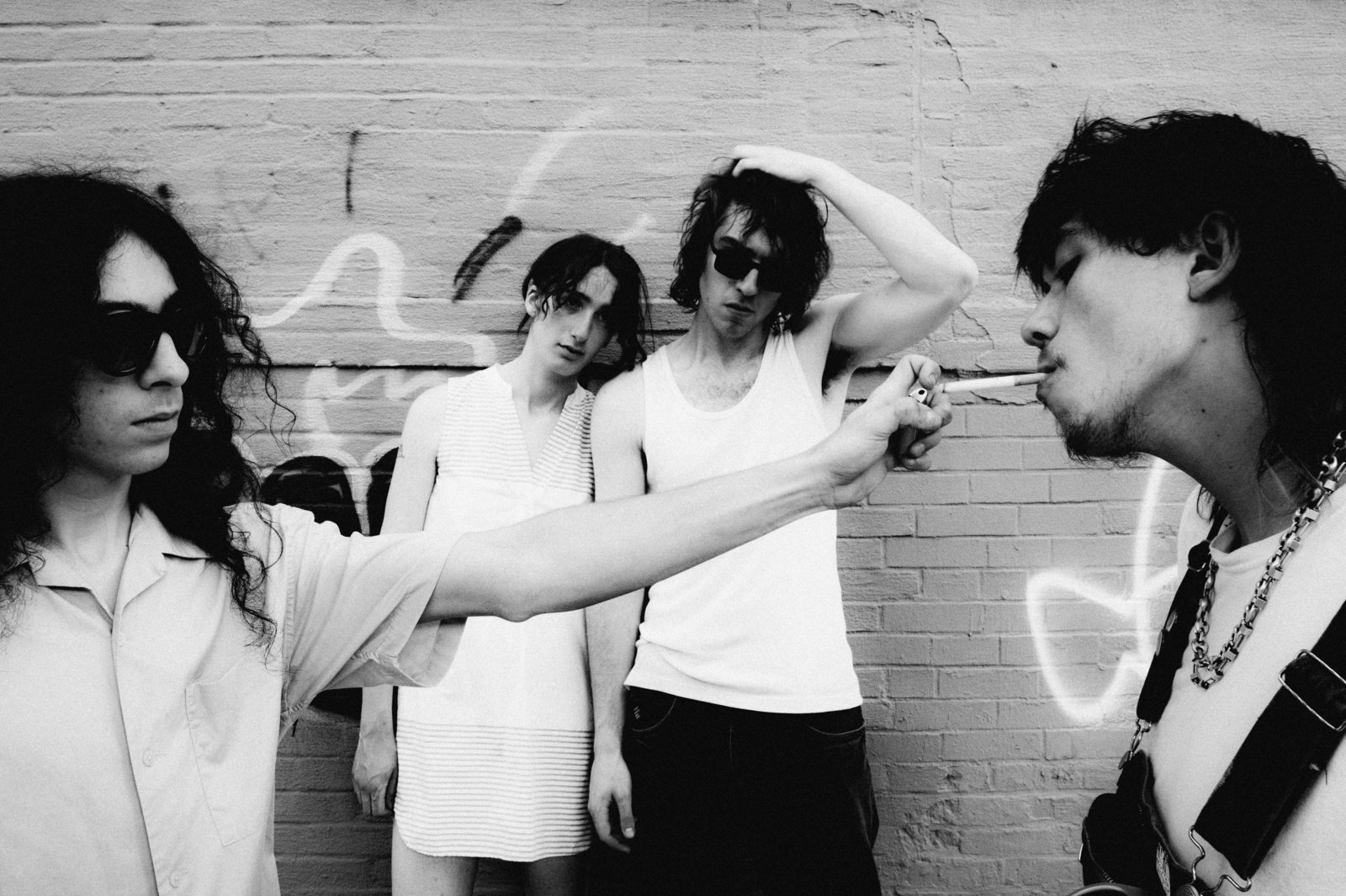
Geese have somehow managed to make a very weird album wonderfully accessible.
Release date: September 26, 2025 | Partisan | Instagram | Website | Bandcamp | YouTube
Anyone who has the misfortune of meeting me in person will instantly clock me as a semi-retired theatre kid. A tragic reality, but reality nonetheless. I did a lot of work both on and off stage in college and the handful of years after where I still was under the impression I could do something I enjoyed for money (I cannot). In my sophomore year, I starred in a truly terrible production of Molière’s The Misanthrope. Trust me on this one, people honest to God walked out during the run. It was the most pretentious, incomprehensible shit imaginable from a theatre program that was, well, both pretentious and incomprehensible.
One thing that stuck with me about that play, however, was the soundtrack. Every scene change was scored by a sequential track from Dirty Projectors seminal masterpiece Bitte Orca. The cast – which was all 18-22 year-olds in 2011 – mocked these songs a lot, because they’re objectively kind of odd. I joined in and then listened to the album on repeat in private for years. Young adult me was familiar with a lot of emo, pop punk, and metal, and was raised on folk and oldies, but Dirty Projectors‘ unique mix of experimental baroque pop and pseudo-jazz really had me hooked. It’s been a long time since I’ve heard something that scratched the itch for something listenable but still a bit out there, with unique instrumentation and evocative lyrics.
Enter Geese’s Getting Killed. I went into this album completely blind, having missed 3D Country in its entirety despite being aware of much effusing online. My bad. While ‘art rock’ or ‘indie’ may vaguely encapsulate the nature of Getting Killed, the reality is that this album lives somewhere very strange sonically. I’ve seen it referred to as ‘shambolic’, and after googling that because I am an uneducated swine and this term might be British slang, I am inclined to agree. ‘Disorderly and chaotic’ indeed. I noted during my inaugural listen that many tracks felt improvised, or more like they were magically spawned in the booth. There are a ton of influences I can pick out immediately, but think of Getting Killed as a swirling, weirdo cauldron containing bits of the aforementioned Dirty Projectors, Grateful Dead, Modest Mouse, Tropical Fuck Storm, and a lot more that I’ll probably mention later. ‘Esoteric’ doesn’t begin to cover it.
We open with “Trinidad”, an immediately off-kilter track that feels a bit like half of King Gizzard & The Lizard Wizard suddenly experienced mania while on a group camping trip. “Trinidad” is the album’s most unhinged song, with alarming yells and unpredictable guitars (courtesy of the excellent Emily Green), but it serves as a good introduction to what exactly you’re getting into, especially when paired with the following track, “Cobra”. While the former may come across as discombobulated and even aggressive, “Cobra” leans heavily on sweetness, featuring twangy slides and singer Cameron Winter’s signature emotional crooning. The contrast between the first two songs cuts to the core of Getting Killed — the inherent tension between anxiety and celebration, between the organic and the controlled.
Usually, when I work on a review, I have about three or four specific songs I’d like to highlight. Getting Killed was so varied and beautiful that I had to cut this down substantially because I wanted to talk about nearly every single track. “100 Horses” is a huge standout both musically and lyrically, dipping a bit into semi-Western Delta Spirit territory. ‘Only dance music in times of war’ feels, sadly, more relevant than ever. “Au Pays du Cocaine” also really hit me on a lyrical level with ‘you can be free and still come home’.
Lead single “Taxes” returns to the central balancing act of Getting Killed by simultaneously embodying the depressing and the joyous, reflecting on past mistakes (‘I should burn in hell‘) while still adamant that ‘nobody deserves this‘. It’s both heartbreaking and, strangely, religiously ecstatic. There’s the jazzy, Zappa-esque breakdown in “Bow Down”, and the overall use of creative percussion, which reminded me a bit of Ganser’s Animal Hospital, or a much less irritating Edward Sharpe and the Magnetic Zeros. Do you understand why I gave up on cohesive structure here and just started listing shit? There’s simply too much worth mentioning. Getting Killed affected me so deeply, and a lot of that was pleasant confusion. I’m just trying to sift through the rubble.
I’m sure the vocals for any Geese album are a bit divisive. I referred to it as ‘crooning’ earlier, but I want to clarify that this isn’t loungey in the slightest. It’s more emotional, like the sounds are being physically pulled from Winter’s chest as he speaks the often very poetic lyrics. The vocals remind me a lot of Beirut, who are responsible for some of the best indie music of the 2000s, in their rolling, pastoral nature. The complete warbling desperation of the opening words — ‘THERE’S A BOMB IN MY CAR’ — may absolutely turn listeners off, but those intrigued enough will be rewarded for sticking around to hear Winter’s softer moments that nearly brought me to tears more than once. I’m into it, but I can understand why the alternating yelps and howls may be a deterrent for some.
I say give Getting Killed a shot (pun intended) regardless. This is a deeply strange piece of art that kind of feels like a nutcase alternate universe version of Spoon’s Ga Ga Ga Ga Ga. It’s slippery and difficult to describe, but it manages to capture the anxieties of, well, being alive currently, in a truly unique way that not a lot of bands are brave enough to put out there. Normally, I would return to my framing device here and end with some sort of quippy remark, but my nostalgic rambling pales in comparison to the actual ending of the album given to us by Geese in the closer “Long Island City Here I Come”:
‘Nobody knows where they’re going
Nobody knows where they’re going
Nobody knows where they’re going except me
Here I come‘
Yeah. I didn’t know where this album was going, either, but I’m happy that it took me there.