


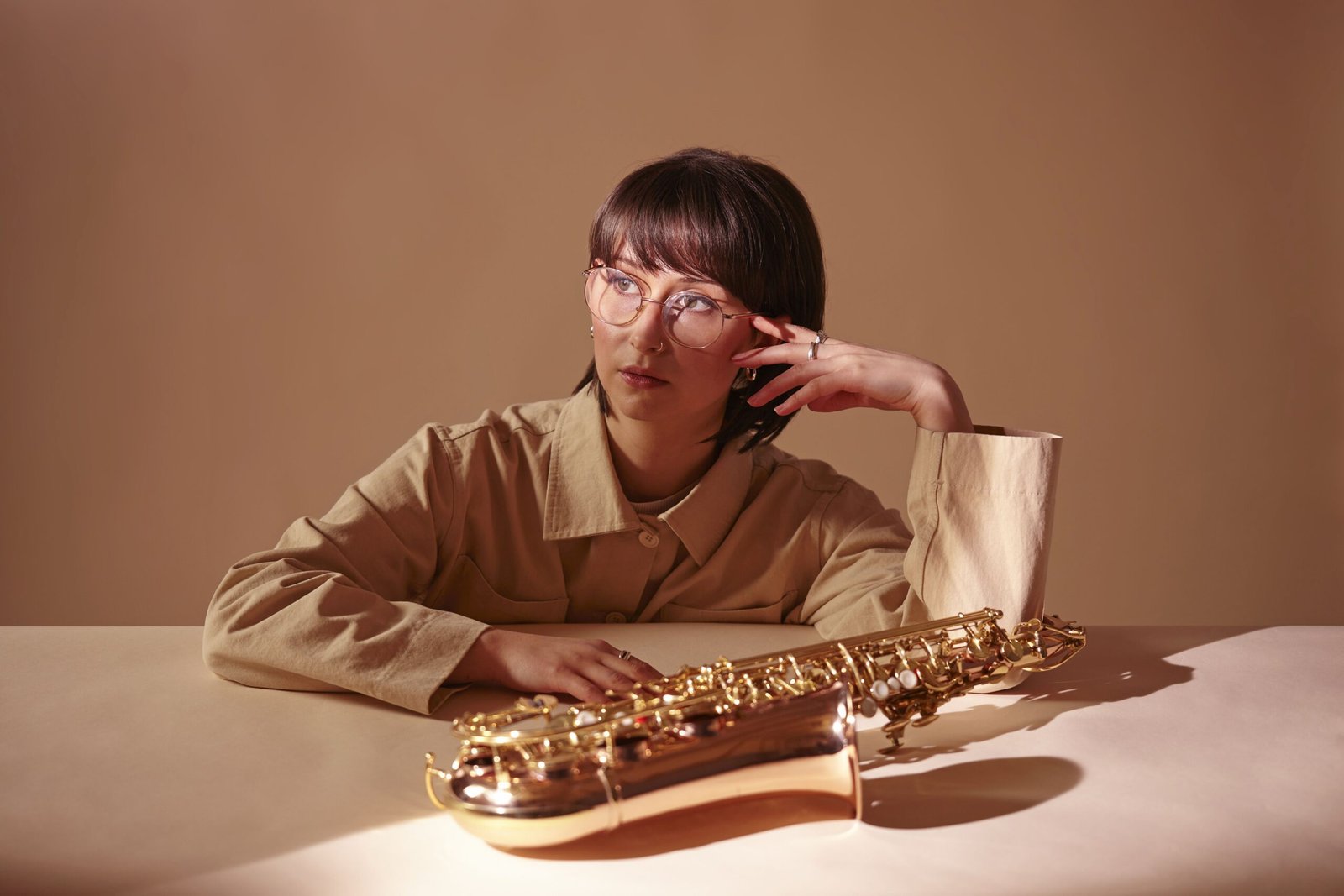
On her third full-length, Jasmine Myra weaves a deeply affecting tapestry of entrancing, textured jazz.
Release date: May 15, 2026 | Gondwana Records | Instagram | Facebook | Bandcamp
When I reviewed Miho Hazama‘s Frames last month, I pointed out how, from its very first notes, the album’s dramatic jazz/big band sound immediately grabbed my interest and maintained it throughout its entire rolling, dynamic runtime. By stark contrast, UK’s premiere saxophonist/composer Jasmine Myra takes an understated approach on her new album, Where Light Settles – quiet piano plunking, atmospheric strings and harp, spy movie flute tooting – but is no less gripping or engrossing. The eponymous “Opening” track lasts for two minutes, never rising above a gentle whisper, so close to the ear that the intimacy could reduce someone to tears. Such is also true for the remainder of Where Light Settles, an album that goes some way towards truly touching the lofty ‘spiritual jazz’ label.
Compared to other practitioners of the sub-genre like Kamasi Washington, whose free jazz influence has made him into a modern day inheritor to the whacked-out lineage of players like Pharaoh Sanders, the works of Jasmine Myra touch on a more emotionally affecting area of the human psyche. Her previous two albums, 2022’s Horizons and 2024’s Rising, showcase a distinct sound rooted in smooth jazz but with a healthy dose of playfulness sprinkled on top. While many of her compositions are on the slower side, they are loaded with instrumental layers and ideas that hold the listener’s attention.
Where Light Settles is no different: “Likeness and Shadow” starts off with steadily-strummed acoustic guitar that wouldn’t be out of place on an indie-folk record, but when Myra appears on her saxophone, it signals an instrumental swell to the other players that effortlessly builds into a marching rhythm and beautiful chord changes. Although this rhythm drops out and re-enters throughout the song, it never loses momentum: the evident passion coming from this 13-piece band gives it a beating heart. It’s a moving, wonderful piece that shows just how far Myra’s compositions have come over the years.
The deliberate pace of “Echo” recalls the atmospheric nu-jazz of GoGo Penguin (a high compliment), while “Fragments” starts off like the opening theme of an HBO series about a dysfunctional-yet-loving family that owns a funeral home (a VERY high compliment) before the drums assert control with excellently placed cross-sticking and rim hits. However, “In an Instant” takes the cake as the best song here: it’s also the longest at eight minutes, and over the course of that timeframe Myra and her players pack in as many sublime musical ideas as possible. The swaying waltz feel is gorgeous, the haunting piano lines underpin the elegant sax and flute parts magnificently, and when she finally opens up toward the end with more aggressive playing, Myra showcases not only her talents but her tastefulness. Instead of letting loose with atonal screeching and noodling, she instead peppers in some quick, staccato runs on her instrument, not one of which overstays its welcome or overshadows her backing band. When the song’s initial motif is reprised in its final moments, the cumulative effect is radiant and extraordinary.
The title track’s light bossa nova-ish feel is a welcomely tidy end to one of the most relaxing-yet-stimulating albums I’ve heard this year. Jasmine Myra proves that this generation hasn’t completely lost interest in art that doesn’t constantly bombard the listener with sound and fury to retain their focus. To engender emotional investment in a project such as this without resorting to incessant instrumental fireworks is an impressive achievement in itself, but Myra and her backing band’s sophistication gives Where Light Settles so much character across its tracklist. Over the course of its 41 minutes, one can hear the players exercising restraint, giving only what’s needed to allow each song the proper breathing room to develop organically. Every new instrumental layer is thoughtfully placed in consideration of the overall disposition of the song in question, and the compositions are all the stronger for it. If you’re looking for the soundtrack to your next meditative night at home, look no further.





Great article! Do want to point out that it is tenor saxophonist Matt Carmichael who solos in In An Instant (and Myra confirmed this during a listening party).