

‘It would be fair to say, though, that So was Gabriel’s commercial high water mark, the album that earned him the most fans, and the one that spread his influence widest.‘
-Iain Ferguson
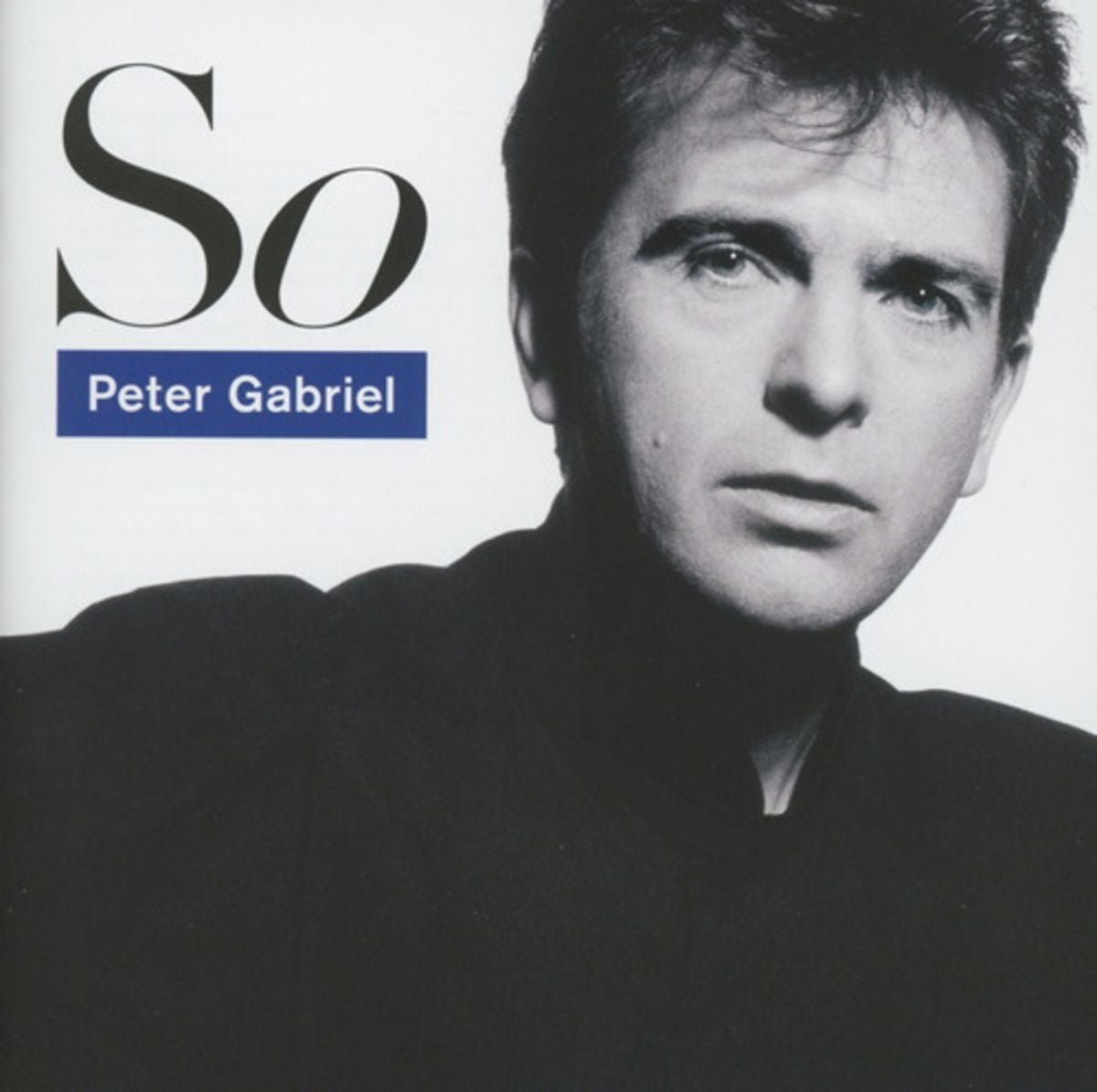
Release date: May 19, 1986 | Charisma/Virgin/Geffen | Facebook | Instagram | Twitter | Website
Here’s a man whose work ideally requires no introduction – prog rock legend, art pop maverick, world music pioneer, Peter Gabriel has been all that and more for over five decades at this point. So marked an obvious commercial peak in his career, which was achieved by streamlining his experimental approach and various influences into a magnetic pull of mass appeal that hasn’t lost any of its charm in the 40 years since its 1986 release.
Iain Ferguson
By 1986, Peter Gabriel didn’t really have to prove anything about his musical credentials. His stint in Genesis left a legacy of excellent progressive rock that’s still beloved to this day, as well as establishing his reputation for theatrics and visual flair. His subsequent solo work likewise showed little regard for genre convention, hopping styles with a free experimentalism, synthesizing his progressive roots with his love for world music and a knack for hooky pop songwriting. The first WOMAD world music festival was largely organized under Gabriel’s direction. Hell, he even managed a solid hit with the whimsical “Solsbury Hill”.
The one place where one could try to argue that Gabriel was lacking was commercial viability. Sure, his albums sold well enough. Compared to his old Genesis bandmates (as a band or solo) though, Gabriel hadn’t quite burned up the charts with any of his first four albums. As you can imagine from this rambling preamble, 1986 marked the year that all changed. The year Gabriel topped the charts and became an MTV sensation. It was the year of So.
Even down to the cover art, almost everything about So felt like a streamlining (but not an abandonment) of Gabriel’s image for greater accessibility. It was the first time his face was presented unaltered on a cover. It also marked the first time one of his albums was officially titled, jettisoning his magazine-inspired approach of every album just being called Peter Gabriel but with different art. The production was absolutely gorgeous in that spacious ’80s style, handled expertly by Daniel Lanois, whose own credential span as widely as Brian Eno‘s Ambient 4: On Land, U2‘s Joshua Tree, and the soundtrack of Red Dead Redemption 2.
Most vitally, though, was the songwriting. Peter Gabriel was just at his pristine pop best across So, and the world rewarded that in kind. Of course I have to start at “Sledgehammer”, the funk and soul-inspired banger (plus some world music love with its shakuhachi flute sample) that gave Gabriel a better number one hit than his Genesis comrades ever managed (as much of a pop Genesis apologist as I am, come on, they had way better pop songs than “Invisible Touch”). The similarly dancey “Big Time” likewise just plain slaps, working slick verses and hooky choruses around bitingly satirical lyrics about chasing fame and success at any cost. Gabriel even dropped another silver screen-ready monument with the heavily afrobeat-indebted “In Your Eyes”, an absolutely gorgeous love song that likely still evokes memories of John Cusack holding his radio aloft for thousands.
Beyond those biggest hits, though, Gabriel further shows a great amount of diversity and craft across So‘s runtime. “Don’t Give Up” marked his second song to feature Kate Bush, and remains an especially stark and heartbreaking ode to perseverance when it feels the world has left you out of work and options. “Red Rain” is grand and dramatic in all the best ways, kicking the album off on a massive emotional high. “That Voice Again” feels especially ’80s in retrospect, awash in Fairlight synthesizers and layered instrumentation revolving around some great choruses.
The sparse, moody textures of the Anne Sexton-inspired “Mercy Street” make for one of my favorite Peter Gabriel songs, full stop. His haunting vocals over spare Brazilian percussion create a haunting effect that keeps me in chills and goosebumps for the song’s entirety. It should be noted, too, that Gabriel’s experimentalism does creep back out towards the album’s end. The sort of hostile discomfort that marked his third album (Melt) inflects the uncomfortable “We Do What We’re Told (Milgram’s 37)”, while his reworking of Laurie Anderson collaboration “This is the Picture (Excellent Birds)” is delightfully abstract and loose in its structure and lyricism.
It has to be noted, too, that looking into the credits and history of this album is an absolute delight. Take “Sledgehammer”, where bass god Tony Levin achieved his tone by stuffing a baby nappy beneath his strings, or how he handled fretting while Jerry Marotta drummed on the strings to create that striking bass tone on “Big Time”. Beyond handling the drumming for “Big Time”, The Police‘s Stewart Copeland is featured on “Red Rain” specifically to play that rain-like hi-hat and cymbal pattern that persists across the song. Jim Kerr of Simple Minds is somewhere in the backing vocal mix of “In Your Eyes”, while obviously the breakout performance by Youssou N’Dour steals the show. That haunting low vocal line that echoes the main vocals of “Mercy Street”? Gabriel could almost exclusively perform those takes immediately after waking up from a night’s sleep.
The artistry even extended to visuals, as Gabriel used songs from So to try to elevate music videos as an artform. The stop-motion marvel that is “Sledgehammer” had to have been a massive labor of love for Gabriel and the crew who worked on it, even featuring early work from Nick Park who would go on to create Wallace & Gromit (a childhood favorite of mine). To say that video was a hit would be putting it mildly, and I believe it remains the single most played video in MTV history. “Big Time” likewise featured a visually stunning mixed media project that still looks just plain cool to this day.
So was a watershed moment for Peter Gabriel. His big commercial break, managed without compromising his musical vision in the slightest. It was a massive chart smash, and made Gabriel a household name that could rival his old bandmates in recognition. And it was a CD that I nabbed from my mom’s CD stack when I heard “Sledgehammer” on the radio and had to know more about the musician who dropped such funky gold. It kicked off an appreciation for Gabriel’s works that never flagged for me, and even if I wouldn’t call it my absolute favorite from Gabriel (that honor goes to Melt), it’s still an album that means a whole lot to me. One I used to listen to with my now passed-on mother, one that can give me chills and nearly bring on tears as easily as it can get me grooving. One that causes me to launch bowling balls down the wrong lane because of hype that my “Sledgehammer” request got played in the alley (much to my wife’s amusement).
Of course, Peter Gabriel has persevered, having since established his own recording studio and managed several more excellent albums that leaned back into his love for world music and experimentalism. His recent i/o was excellent front to back, and I’m extremely eager to hear the forthcoming o/i. It would be fair to say, though, that So was Gabriel’s commercial high water mark, the album that earned him the most fans, and the one that spread his influence widest. And you know what? 40 years on from its release, it still holds up just wonderfully. So here’s to 40, So!