

Post-rock pioneers Russian Circles continue deconstructing the sonic blueprint of sound on Nine.
Release date: August 28, 2026 | Sargent House | Instagram | Facebook | Bandcamp
Russian Circles have always been about putting things together. There’s a deliberate scaffolding to the music they construct, as if they have more in common with the STEM majors than they do any liberal arts kids sitting mournfully on the campus drill field. Their previous album, 2022’s Gnosis, was about providing the scaffolding, metal beams driven into bedrock, the load-bearing support for the tons of concrete soon to harden.
On Gnosis, the band experimented with their own aural architecture, dipping their headstocks into layers of molten metal. It thrashed, it black-metaled, it growled and seemed bigger than something that could be done by three dudes with instruments. And this, of course, was nothing new. Gnosis was a continuation of the seven albums that prefaced it, a laborious construction of something everlasting and powerful.
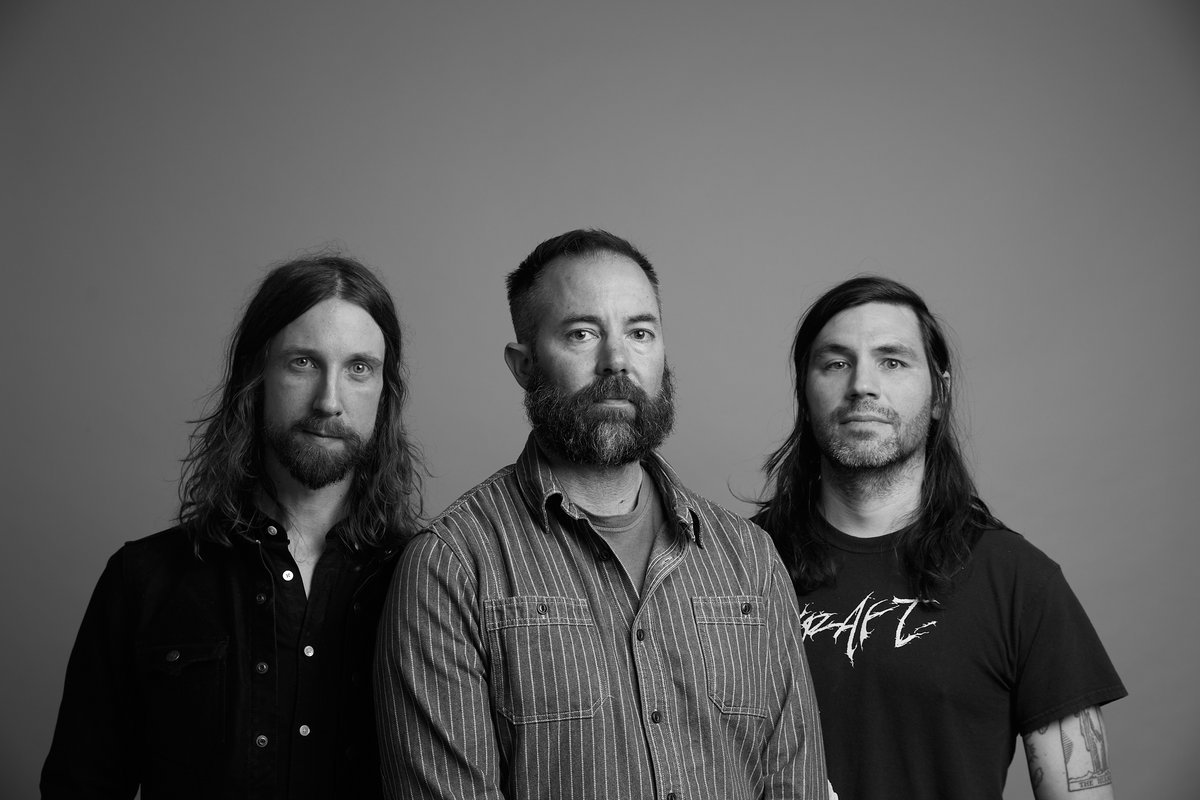
On Nine, the band continues the cycle. The opening bass riff from Brian Cook on “Borehole” is the epigenesis of the new album. Distorted and heavy, the song pummels its way through the oppressive riffage. It’s the sonic equivalent of a stem cell, all potential, and yet the song seems to plow its way into the Earth’s crust, defying planetary odds to create the foundation for something that scrapes against the sky.
The song is a dark, foreboding welcome to the construction site, dust settling from broken ground, acting as an architectural crescendo for the next journey into structural victory. Second song “Empath” enters with a nautical wail, a ship’s horn over a channel covered in fog. The interplay between Cook’s bass, Dave Turncrantz’s drums and the heavy riffage of guitarist Michael Sullivan paint a backdrop of battleship grey, a destroyer sitting in port at the shipyard. Once again, waiting in anticipation of the next great human foray into technological destruction.
This is where it gets a little hard to write about the music that Russian Circles makes. Their songs exist at more than face value, so when looked at as a whole, you can start to hear the visual influences, be it the surveyed property of an old-growth forest facing the mouth of the bulldozer, or the cold steel deck of an aircraft carrier, the Midwest band has left its younger hardcore roots in the dust.
The settling of this dust is where you’ll find these three musicians entrenched. “Eluvial” appears as this sediment settles, and the band experiments with some analog synth sounds that exist in repeated patterns, like the steel beams laid across the infrastructure of the next great skyscraper. “E2” continues with this experimentation (Russian Circles-wise), sounding like Styx on steroids, filtered through the proggiest musical choreography the band has ever flirted with. It’s adding the cement pitting up the glass facade, laying down a snakepit of pipes and wiring to bring the life blood to a new structure.
“E2” fades seamlessly into “Meridian”, the latter opening with a warm, distorted delay-drenched guitar as the drums ease in on the high-hat. It’s a classic Russian Circles move, the kind of song that could have fit in place on any of the band’s previous records from the past decade or so. That’s not to say “Meridian” is filler. It acts as the album’s center point, a way of encapsulating years worth of building in a a few minutes, frame after frame moving through the projector. Cook’s bass tone has always played a massive role in the band’s song-writing, and Nine is no exception.
“Meridian” gives way to the acoustic interlude “Arletta” before ending on the oppressive “Seventh Seal”, a chess match with death itself. In the old days, human beings built things to last. “Seventh Seal” is the deal with the devil, a chance at architectural immortality. It’s a doom-driven slog through the near future, and a fine closing to another brick in Russian Circles‘ sky-scraping wall.
At twenty years old, Russian Circles is ancient in terms of this breed of post-metal instrumental rock. Nine is a testament to the band’s willingness to stay steeped in what they’ve crafted over those two decades, as well as keeping one of their six eyes focused on the future. The band is one of the few who, perhaps, acknowledge that what they are building will be still standing proudly long after they’ve gone. That’s not to say there’s some grandiose posturing in the music the band makes; they are far too Midwestern to be that prideful. The songs on Nine are carefully crafted pieces of aural architecture, and while they may not be immediately noticeable (nor do they strive to be), they will always be there when you need them. And sometimes that’s all you need to have.