Bellbird‘s brooding, cacophonous take on jazz pays dividends on their fascinating sophomore album The Call.
Release date: February 6, 2026 | Constellation Records | Instagram | Facebook | Bandcamp
All online reviewers like myself owe a debt of inspiration to the internet critics of yore, and none has remained so essential to my journalistic style than Red Letter Media‘s own homicidal, possibly demonic Mr. Plinkett, who infamously stated that jazz is ‘not music; that’s just terrible, terrible noise.’ Of course, any music type or musician like myself wouldn’t dare cast so wide a net across an entire genre spanning a century and attempt to retain credibility – unless it’s pop country but we all knew that already (that homogenized slop is in the throes of AI takeover chiefly because it’s the most easily imitable). Jazz on the other hand has remained a haven for both harsh experimentation and sublime blankets of smooth sound; one would be hard-pressed to find someone who doesn’t enjoy the cool 5/4 shuffle of Dave Brubeck‘s “Take Five” or the eternal earworm of Miles Davis‘s “So What”.
Last year I covered two mutant jazz-metal hybrids – Shardik‘s Cruelty Bacchanal and CKRAFT‘s Uncommon Grounds – which fully explored the genre’s sonic possibilities while also being utterly distinct in their own uncompromising, gleefully obtuse ways. Somewhere (Montreal to be exact) in the midst of all this, Bellbird craft their own unique take on jazz with The Call. Unlike Shardik‘s kitchen knife violin or CKRAFT‘s polka accordion, outside influences like indie rock creep into some of the song structures here, grounding the more out-there ideas to create a legible image. It’s a tough balancing act, but Bellbird successfully put their own spin on a time-honored sound that feels both fresh and warmly reflective of the genre’s roots.
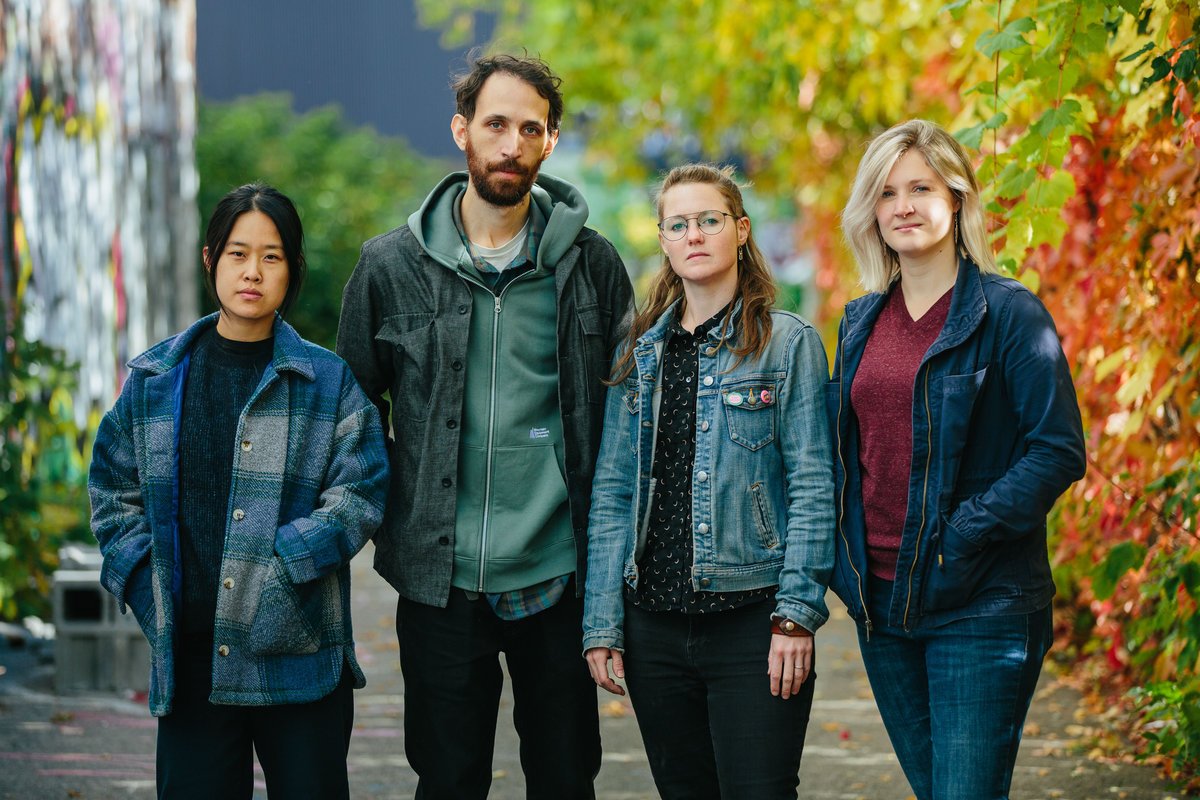
The quartet – consisting of drums, double bass, and two saxophones – could never be accused of ignoring the classics. Their work on The Call is constantly unpredictable, shifting on a dime from the title track’s atonal sax squawking (which Bellbird noted is intentional) and stuttering drum beats, to tribal percussion and hypnotic, repeating harmonies, as on the superb “Murmuration”. The more traditional pieces, such as “Phtalo Green” and “Soft Animal”, feature expressive playing and admirable restraint, proving the potentially immortal Mr. Plinkett is just not very well-versed in jazz’s melodic side. It shows a willingness to pull from several different subsets and spinoffs from the core ideas – the aforementioned title track features stunning performances in an extremely focused structure, allowing Bellbird to get aggressive in a way that jazz fusion titans like Mahavishnu Orchestra used to excel at. The song’s second half is a genuine surprise though: after the intensity established earlier, the band breaks things down to a slower common time but sacrifices none of their drive, plowing through the now-power ballad with precision and passion. The final melody lingers in the mind long after the curtain falls; it’s an unforgettable spell the group weaves.
“Blowing on Embers”, true to its name, sounds like it’s on the verge of exploding at any moment, recalling Ornette Coleman at his most abstract. When the song descends into Hell around the halfway point, the band dunks the listener’s head underwater over and over, barely allowing any breath before the next rhythmic punch knocks everything on its ass. The song’s final leg is nothing short of astonishing, with drummer Mili Hong pushing the other musicians into a frenzied march to the finish line. Saxophonists Allison Burik and Claire Devlin sync up and toot out another memorable harmony, while double bassist Eli Davidovici provides a rapidly beating pulse underneath. When a vocal-less band is able to convey the gamut of human emotion over the course of a single song, one knows they’re in the presence of greatness, and this song is a high point in a tracklist that is almost uniformly strong.
Bellbird‘s strength primarily lies in their excellent taste, utilizing any and all influences at their disposal. In the mix with both the noodly excursions and the ballads is a song like “Eternity Perspective,” a mostly straightforward and accessible melodic piece that, despite a beat change here and there, maintains its feelgood tone and proves the most carefree song in the bunch. Call it Masayoshi Takanaka on a particularly pensive day. It provides a necessary contrast to the woozy dejection of a tune like “Mourning Dove”, which walks with the gait of someone who knows they’re cool but bad things keep happening to them – appropriately, the song’s conclusion features some cheerfully freeform drumming and bass while the saxes quietly secede. It’s during these moments that Bellbird most compellingly achieve their stated goals: to explore ‘themes of interconnectedness between musicians, genres, and the natural world.’ Listening to The Call with eyes closed, one can almost picture a nature documentary: the frantic chase and eventual capture in the cathartic “Firefly Pharology”, the stealthy but bloodthirsty hunt of “Murmuration”.
With just four instruments and what sounds like no overdubs, the band works best while in exploratory mode, allowing the songs to develop organically from section to section, as opposed to the lower-energy traditional sound they occasionally dip into. I hope they continue in that direction for album #3, because Bellbird have a new fan, and for any fan of jazz or the avant-garde, The Call should prove just as fascinating to you as it has for me.