

‘[Time’s Up] proves that Living Colour as a band were not a fluke – nor were they meant to be a token.‘
-Joseph Krebaum
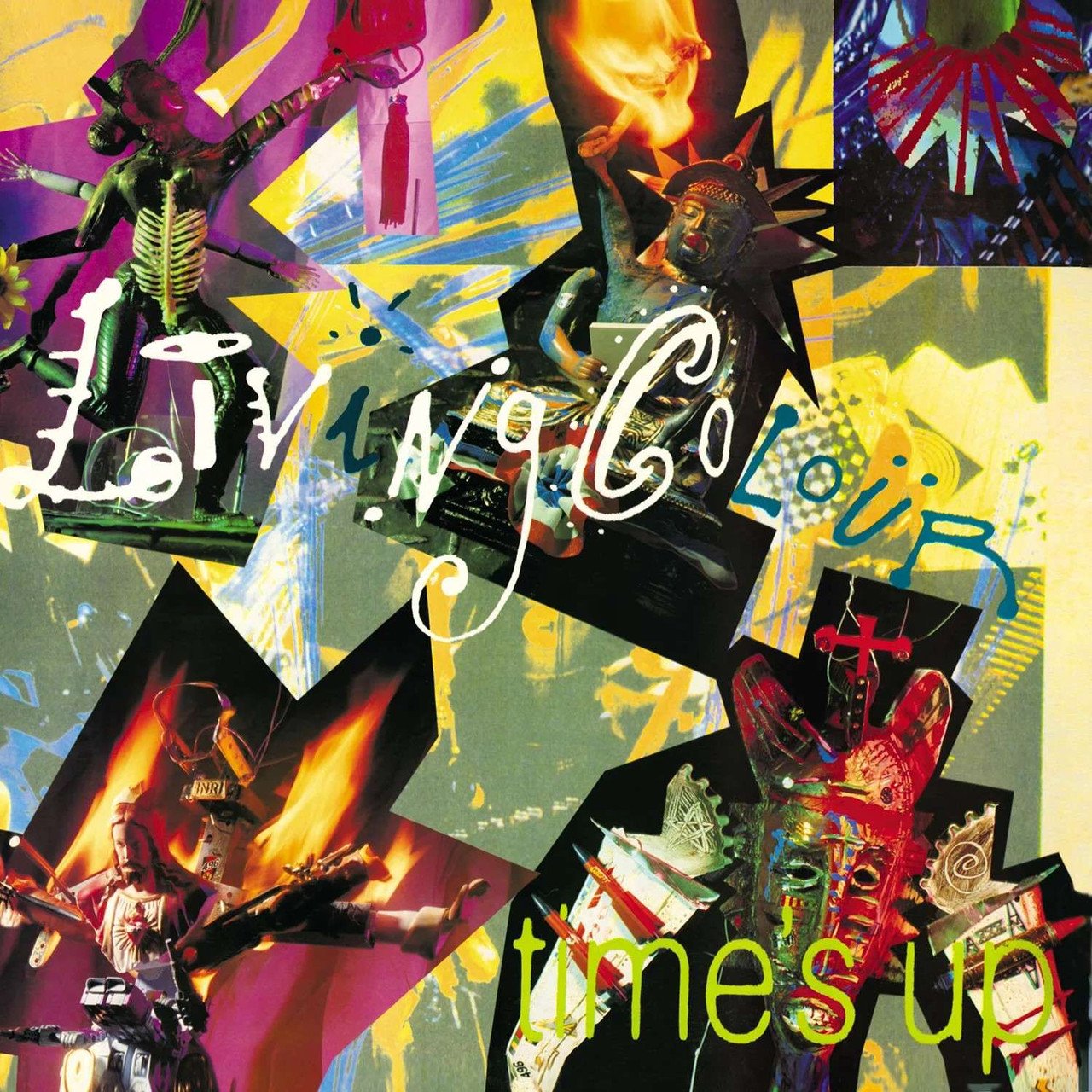
Release date: August 28, 1990 | Epic | Facebook | Instagram | Twitter | Website
Where do you go after releasing a landmark record? Do you stagnate under the weight of expectations, or do you try to push for something else entirely to offset the prying eyes? In Living Colour‘s case, they did neither; instead, they went onward and upward, taking the sound they set with 1988’s Vivid to awe-inspiring new heights with Time’s Up, a record that’s heavier, more playful, and more diverse than its already impressive predecessor.
Joseph Krebaum
Prior to signing up for my first A Scene In Retrospect, I was unsure of how this experience would turn out. Living Colour’s certainly been on my radar for a while as a pioneering, all-black alternative metal outfit, but outside of one particular single, “Love Rears Its Ugly Head”, I hadn’t heard their sophomore album Time’s Up in full until recently. I was much more acquainted with their 1988 debut Vivid, on which “Cult of Personality” can be found. Like many of us, that was my introduction to Living Colour, and while Vivid was an intrepid idea that broke barriers at the time, the execution seems just a tad bit tame to me now, which was perhaps why I was initially reluctant to cover this.
It makes sense, though. Vivid’s classic production was more grounded in a 1980s hard rock style, whereas future releases either became sonically heavier (Time’s Up) or went thematically edgier (Stain). Which begs the question: were Living Colour really an ’80s band? Or were they spiritually a ’90s act who happened to inhabit the decade prior?
Time’s Up does its damndest to answer ‘yes’ to both questions.
Released the same year as other ’80s-meets-’90s masterworks, such as Depeche Mode’s Violator album and Alice in Chains’ debut Facelift, Time’s Up is simultaneously an artsier affair and a gnarlier maelstrom of guitarist Vernon Reid’s riffs. Together with powerhouse vocalist Corey Glover, the interplay between then-bassist Muzz Skillings and Will Calhoun on the skins, and returning producer Ed Stasium, Living Colour remain a semi-metallic force to be reckoned with. Listening to the environmentally conscious title track, you’d think these guys were influenced by hardcore speed stalwarts Bad Brains – oh, wait.
‘Without Bad Brains,’ said Reid in a November 2023 interview with Guitar World, ‘we probably wouldn’t exist. They were such an essential component of how we arrived.’ Such influences are an anchor for Living Colour’s eclectic congregation of blues, funk, jazz, punk, r&b, and progressive rock music. No matter how chaotic this album is, as evidenced by “New Jack Theme”, “Elvis Is Dead”, and my new personal favorite, the communication breakdown that is “Information Overload”, Time’s Up retains a unified identity at its core. I imagine that that’s not easy to do on an album injected with flashy-as-fuck guitar shredding and proto-Rage Against the Machine-style effects.
For all that Time’s Up did to popularize not just the early-to-mid-’90s metalloid wave but funk metal in general, few others seem to acknowledge the impact that this record has today. “Love Rears Its Ugly Head” was a Modern Rock chart hit for Living Colour, with the album winning them a second Grammy Award for Best Hard Rock Performance. Outside of objective metrics, the group’s cult following expanded considerably as well, bridging the divide between white and black audiences in the world of hard rock and heavy metal. Most of all, though, Time’s Up tightly packs a surplus of social commentary reminiscent of the transition from 1980s traditionalism to 1990s activism all within approximately one hour. The special guest stars on the album, like James Earl Jones (“History Lesson”), Little Richard (“Elvis Is Dead”), and rapper Queen Latifah (“Under Cover of Darkness”), enhance the album’s pop cultural status without sacrificing quality compositions for celebrity clout.
My honest opinion on this album, at least once I heard the whole thing for the first time, is that even with the high potential established by their smash debut Vivid, this record juices up Living Colour’s harder-edged rock roots while also progressing with even sharper political messages and riffs with real flavor. It proves that Living Colour as a band were not a fluke – nor were they meant to be a token. As an album title, Time’s Up is a real misnomer. Out of context, it could be taken to mean that this band’s career was over. Actually, they were just getting started.
Brandon Essig
I first heard Living Colour sometime in my childhood years; my dad worked with guitarist Vernon Reid on some of his solo music way back in the day (mid-’90s, I assume) so their music was well-appreciated in my home. By the time I got around to doing a deep dive on the band’s discography – about 5 or 6 years ago – I was struck by the mélange of influences and how seamlessly they were integrated with each other. An all-black metal group is still rare to come by, which makes their initial three-album run all the more impressive for its blend of soul, funk, and heavy rock styles. 1988’s Vivid put them on the map with the still-timely “Cult of Personality”, but 1990’s Time’s Up remains my favorite of theirs from front to back; the group’s pop sensibilities were in full force while they simultaneously explored the outer reaches of their established sound (1993’s sadly underappreciated Stain is for the fans who like their metal especially crunchy).
The four-piece had a looseness to their early work that showcased their wide-ranging influences. On Time’s Up, they wasted no time going for broke and showing their mettle. Songs like “Information Overload”, “Someone Like You”, and the title track have Reid’s mind-melting guitar work all over them; his riffs bounce and grind, his solos transport the listener to another realm entirely through sheer speed and fluidity. Vocalist Corey Glover is an emotional powerhouse on ballads like “Solace of You”, which works in West African and reggae sounds and remains the loveliest song in the band’s catalogue. Will Calhoun’s drumming gives songs like “Type” a shifting, dynamic single, and bassist ‘Muzz’ Skillings underpins songs like “Elvis is Dead” with pulsating rhythms. Even with the outstanding musicianship at play, the lyrics remain a high point, excavating social critique around the powers at play and their effect on urban neighborhoods: displacement, technology, environmentalism, and even the music that Living Colour play are all topics examined across Time’s Up, and their skill at verbalizing them remains timeless.
Despite the fact that they remain active and continue playing live (although since reuniting in 2003 they’ve only released three more albums, the last of which was in 2017), it’s a shame that Living Colour haven’t gone down in history as not only an important band culturally, but one that released some of the 90s’ best commercially-minded hard rock music. The group has stated that because they got famous so early in their career (not many rock groups can boast that Mick Jagger was such a big fan that he produced their debut album), they saw how the game was played and immediately got out. More power to them, because Time’s Up is a high watermark in mainstream rock music and one that I implore people to check out if they’re fans of any of the styles included in the mix. It still sounds just as fresh today, and that’s no small feat.