

Jazz fusion giants Snarky Puppy visit their friends in the Netherlands (again) for some of their lushest work yet.
Release date: November 21, 2025 | GroundUP Music | Bandcamp | YouTube | Instagram | Streaming
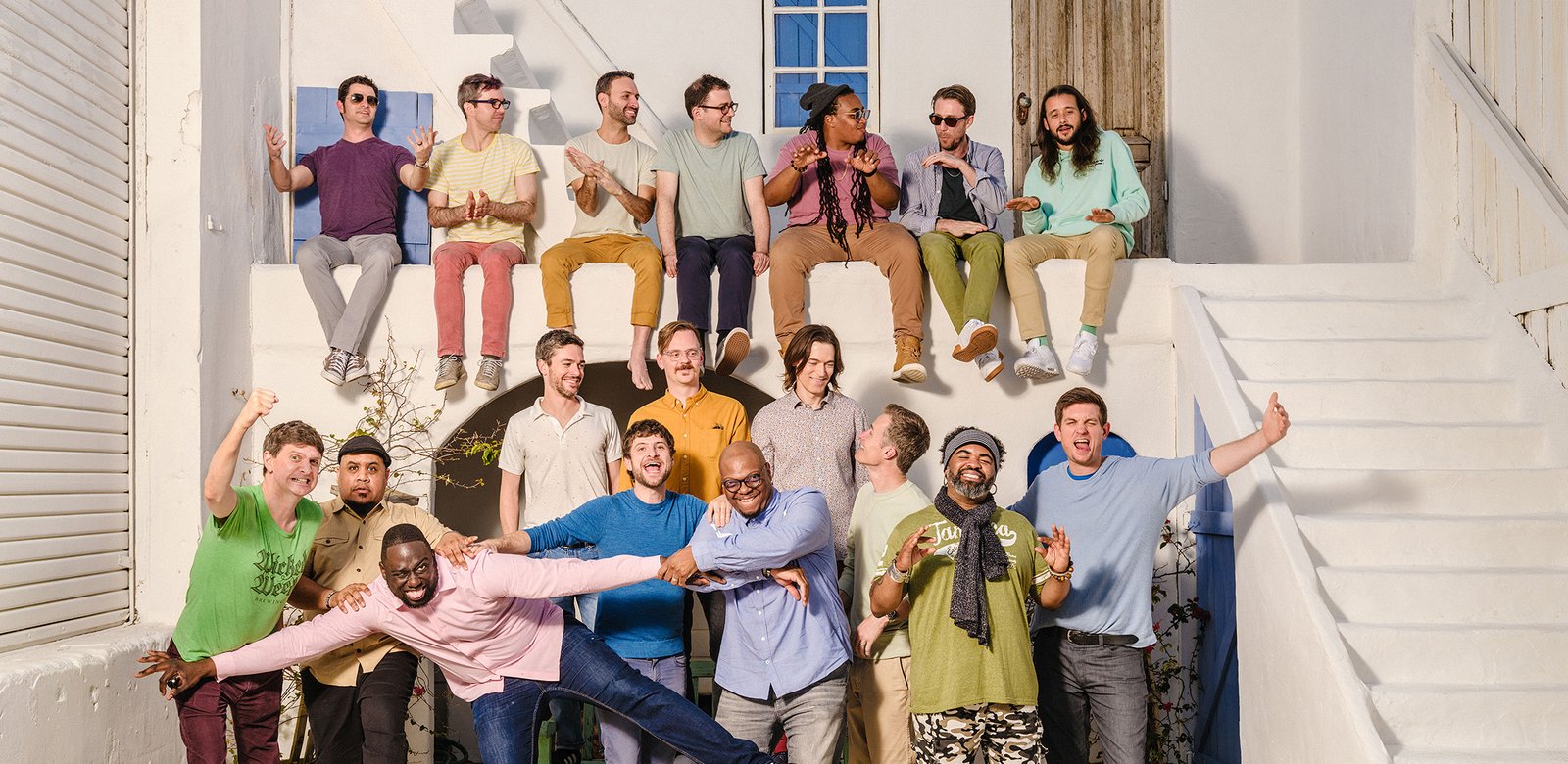
Like any human person who was online in 2014, my introduction to Snarky Puppy came courtesy of the music video for “Lingus”, which as of today has over 11 million views. That’s wild for anything that isn’t pop or rap, but especially wild considering that Snarky Puppy, the ever-revolving collection of about two dozen musicians, is, at heart, a jazz band. “Lingus” is a great snapshot into what to expect from this group – deep, grooving funk, mind-melting solo sections, and an overall sky-high level of musicianship that is hard to find matched in more popular spheres. I was completely blown away.
Then, I forgot about it. I’m not sure if Snarky Puppy‘s output simply surpassed me due to graduating from college and moving across the country, or if I fell into different genres as a no-longer band geek. When I did get the urge to revisit jazz, I found myself more drawn to the then-ascending Vulfpeck cinematic universe, leaning more into the guitar and bass-focused work of incredible artists like Joe Dart and Cory Wong. I think I tried to listen to 2019’s Immigrance, and while I’m sure I enjoyed it at some level, it didn’t really get its claws in me the way We Like It Here, the home album of the aforementioned “Lingus”, did.
I recalled hearing Metropole Orkest on a Cory Wong song this past year, and when I saw that they were teaming up with Snarky Puppy, I decided to give them both another spin. Boy, am I glad I did. This was not the middling listening experience I’d had a few years ago – this was sending me right back to watching YouTube with my mouth hanging open like an idiot, hunched over my phone with the other members of the jazz ensemble.
Somni is the collaborative effort of Snarky Puppy, the Dutch orchestra Metropole Orkest, and their conductor Jules Buckley, who is credited separately. Metropole Orkest boasts nearly 100 members alone; add in the constantly-expanding cast list of Snarky Puppy, and you have a recipe for a truly massive sound. The album was recorded live in front of an audience in a concert hall, like the previous fling of the two groups Sylva, which I missed in its entirety, but am now tempted to go back and listen to.
The sheer amount of players on stage is immediately clear upon the first notes of album-opener “Waves Upon Waves”; this is going to be immense, lush, and (somewhat obviously) highly orchestral. Beautiful violins and violas swim high above polyrhythmic drums and funky organ. A wobbly synth plays the countermelody to a huge section of trumpets and other brass. This is old meets new in a perfect harmony – the tradition of the classical orchestra meets the wild, unrestrained nature of jazz. “Waves” is also a wonderful way to set the general tone of the album as delightfully cinematic. I found myself frequently imagining this as the score for some long-lost 1960s Bond film with the wistful quality of the wind instruments, particularly the flute, intertwining with the more contemporary wailing of the tenor saxophone.
While the first handful of tracks may lean more towards Metropole Orkest‘s wheelhouse, “Chimera” firmly sounds like a classic Snarky Puppy composition with its pulsing, charging bassline and off-kilter rhythm guitar that sounds a bit like Mark Lettieri had a few too many at the bar before stepping onstage. This energy is a nice change at this point in the adventure that is Somni, bringing the previously retro-sounding tracks a bit more into the now.
“Recurrent” is the longest track on the album, clocking in at nearly 14 minutes long. Somni is certainly a bit of a marathon in and of itself at 72 minutes, and while I’d complain about that in pretty much any other genre, I’m not about to here. This is a live album, after all, with the crowd noise left in for extra immersion, and I have absolutely no problem strapping in for over an hour of wordless, swirling improvisation sitting atop some truly stunning compositional work. Anyway – “Recurrent” is an excellent exercise in improv, taking the standard jazz approach of a few main sections and hooks and leaving plenty of room for individual members of this massive collective to take the reins and go absolutely crazy on it. The ‘recursion’ in question is a twitchy little figure that we first hear in the opening notes from the piano that gets passed around to most other sections of the band, weaving in and out while everyone gets their time to shine. It’s a nice reminder of how fucking fun live jazz is to experience, and I frankly think I’d have gotten kicked out of this taping for hooting and hollering during this track in particular.
While the general sound of Somni may be somewhat similar song to song, the musicians do take plenty of time to step outside the vague confines of ‘jazz fusion with an orchestra’ and play around a little bit. “Drift” comes to mind as an example of this. If “Waves Upon Waves” was the soundtrack for a 60s spy movie, “Drift” is the 30s noir equivalent, relying heavily on the saxophone and trumpet sections and plodding along quite slowly, with very little drumming (on an album that has so many percussion instruments I could barely keep track). I was reminded of doomjazz groups such as Bohren and der Club of Gore and The Kilimanjaro Darkjazz Ensemble, great music for brooding and skulking about the shadows like a cyberpunk detective.
Of course, all good things must come to an end, and the closing track of Somni is certainly up to the task. “It Stays With You” is a driving, emotional piece that makes use of every person who made this insane collaboration possible. The strings do their best to pull on your heartstrings (pun intended) with a sweeping riff in a somber minor key, alongside what I think is a theremin for maximum theatricality. Beautiful fingerpicked electric guitar repeats this exact figure later, reminding us again that we are dealing with consummate professionals here, both in terms of the composition and the performances themselves. It’s lush, it’s gorgeous, and it’s a perfect ending to an excellent album.
The last 55 seconds of the runtime are applause. Without a doubt, a standing ovation. Absolutely deserved.