


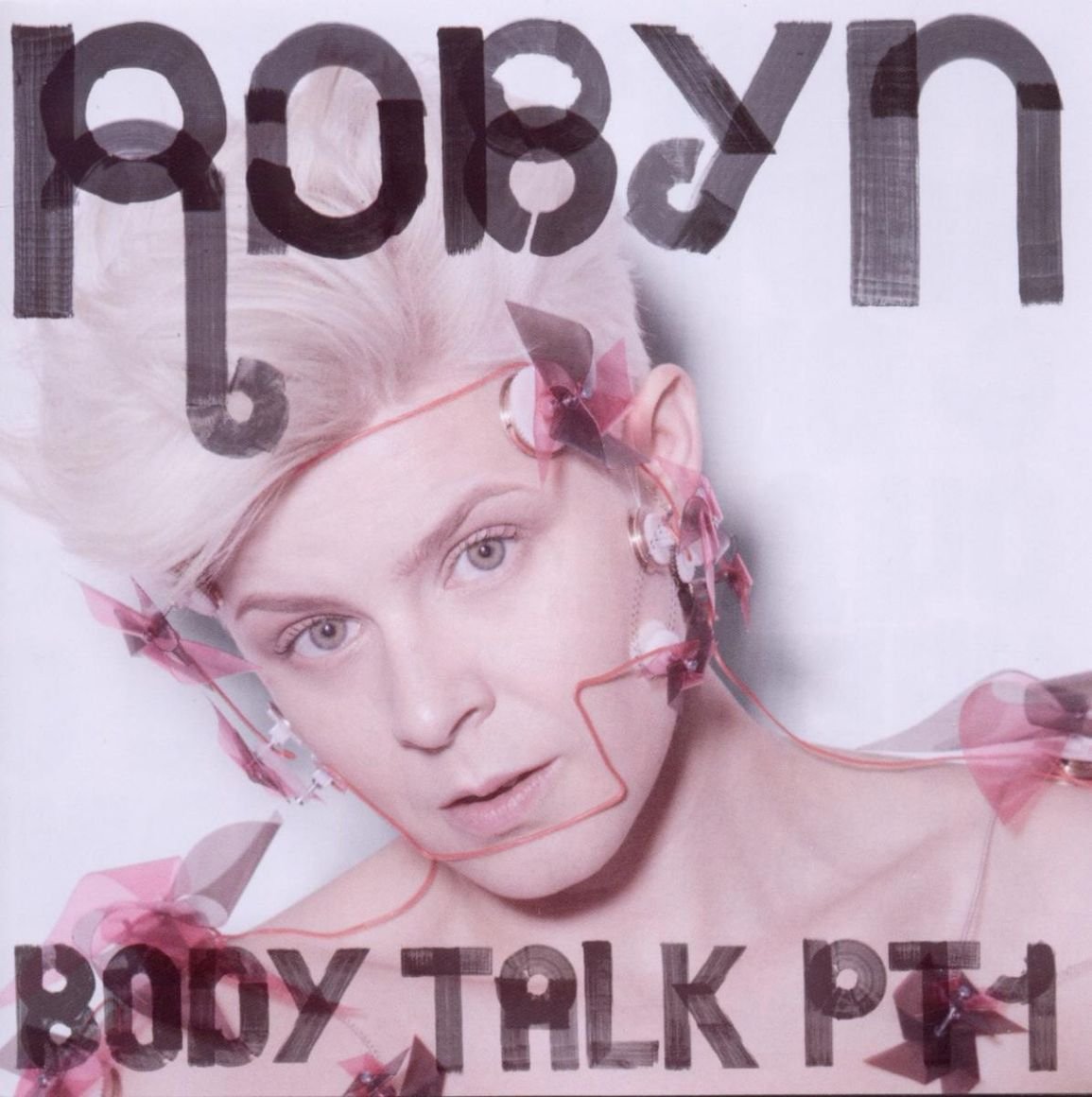
‘Over a decade after I first heard Robyn and lamented her disappearance, she has not only returned, but once again, prominently in my avenue of discovery.‘
-Broc Nelson

Release date: November 22, 2010 | Konichiwa | Instagram | Website
Pop music, especially when designed to make one dance, is often met with its fair share of derision from ‘serious’ music enjoyers. This is met with the reality that dance music can be just as elevating and sublime as any other kind of music. Enter Robyn, whose potential for bubblegum pop stardom was marred by her own demanding attitude towards the quality of her music. Body Talk is the perfect example of her brand of high-energy, tasteful electropop.
Broc Nelson
‘Girlie pop’ is the nomenclature du jour for something that has existed for nearly as long as popular music has been recorded, the upbeat and often suggestive music sung by young women. It is a force that may never be quelled. Doe-eyed ingénues sing of the timeless confusions, lusts, adorations, and heartbreaks of young romance will likely always thrive, regardless of the musical or theatrical backdrops. Sex sells, after all, and my young, changing body was one of the target audiences.
In the late 1990s to the mid-2000s, there seemed to be an unending supply of blonde pop stars dropping music videos on MTV, where Total Request Live counted down the top singles in the country in a time slot that was perfect for the after-school crowd. Millions of teens either wanted to be or be with Britney Spears, Christina Aguilera, Mandy Moore, Shakira, Jessica Simpson, etc. There was only so much a teenage boy could take before primal curiosity took over and I forsook my Korn and Black Sabbath listening to stare, transfixed at the TV when those videos came on. Like, ‘only reading Playboy for the articles’, I was just waiting to see where Limp Bizkit and Eminem landed on the charts, that’s all, I swear.
A year before “…Baby One More Time” smashed into teen pop consciousness, there were a couple of singles from a Swedish pop-star that went simply by Robyn. “Show Me Love” and “Do You Know (What It Takes)” didn’t make the same impact, but were still heavily rotated singles in the Billboard Top 100. Robyn, likewise, wasn’t quite as suggestive as Spears or Aguilera, but in that carried a sort of maturity, not only in her lyrics, but her style, the short cropped hair and theatre kid demeanor that didn’t necessarily advertise her sex, but didn’t hide it either.. Her music wasn’t exactly as bubblegum as the others, but her presence was overshadowed into obscurity by the United States’ raunchier and cookie-cutter molded starlets.
For a while, I wondered what happened to Robyn as her early singles gradually dropped from the atmosphere into the fickle memories of pop culture. I was rooting for her. She seemed like an underdog, too impossibly foreign, too mature, too artistic to compete with our domestic girlie pop. It turns out that this was more or less the case. Her label, BMG, didn’t distribute her follow-up album in the United States, allegedly in part because of songs containing lyrics about an abortion. She still had success in Sweden, but my underdog pop queen was essentially silenced for a few years, and I grew tired of teen pop as I entered high school.
During this time, she changed labels, only to have her new label purchased by her previous one, once again leaving her shackled with artistic restraints. So, she decided to start her own label, Konichiwa Records, and in doing so pivoted her music into more club-oriented dance pop. I remained ignorant of this for years. It wasn’t in my interests any longer as I explored a dozen other genres of music, slowly but surely shaping myself into the insufferable music nerd I am today.
That process required a fanatical amount of reading to learn, discover, and refine my tastes, as well as seeking out recommendations from fellow music nerds. Eventually, my blog of choice for new music discovery was Pitchfork who, at the time, was the hipster music blog supreme. In 2010, Pitchfork gave their coveted ‘Best New Music’ designation to Body Talk by Robyn, a sort of compilation of two previous mini-albums (Body Talk Vol. 1 & 2) with some additional tracks added. I was taken aback by seeing this phantom memory resurrected. Over a decade after I first heard Robyn and lamented her disappearance, she has not only returned, but once again, prominently in my avenue of discovery.
I had to listen. How could I not?
Immediately, “Dancing On My Own” stuns. The house bass, twinkling leads, subtle drum machine woodblocks, and soft pads over a softened four-on-the-floor beat carry Robyn’s sorrowful lyrics of witnessing a lost lover with a new flame in a single that is catchy, touching, and endlessly danceable. 15 years later, it is still immaculately praised, landing at number 20 in Rolling Stone’s Top 500 songs of all time list and recently performed by Robyn and David Byrne at Saturday Night Live’s 50th Anniversary show.
The track is so good, it could carry the album by itself, but Body Talk without “Dancing On My Own” would still stand strong. “Fembot” is a bouncing, sexed-up synthesis of a very human urge and very inhuman technology with high-paced, clever lyrics and a textured beat. Oh, and Robyn has completely shed any association with the teen pop I once associated her with, leaning into Parental Advisory stickers with a confidence and maturity that few pop stars could ever replicate. “Don’t Fucking Tell Me What To Do” is a techno-tinged rumination, at once jaded and defiant.
Robyn’s sense of melody and lyricism can cover a wide range of emotions, all laced with an attitude and personality that out-charms most any dance-pop star, and that is matched with production that is rooted in the club scene. These tracks aren’t just replications of trendy EDM from the time, but are full of the kinds of subtle changes and details that make for a truly great electronic dance album. “Hang With Me” teeters on bubblegum pop, but has an addictive synth-pop arpeggio beat that gives the sweetness of the track a surreal retro-futurism. “Call Your Girlfriend”, like “Dancing On My Own”, is a bittersweet banger that deserves classic status.
Robyn explores different shades of pop throughout Body Talk, in ways predicting hyper-pop. “None Of Dem” features Röyksopp in what was my first exposure to the absolute magic that happens when Robyn and Röyksopp collaborate (see Röyksopp’s True Electric for more). “We Dance To The Beat” aligns with DFA-flavored dance punk while “U Should Know Better” with the world’s most famous unc, Snoop Dogg, fuses dance and rap long before Vince Staples or Danny Brown. “Dancehall Queen” goes full dub while maintaining the brash bravado of “U Should Know Better”.
In the time I have been thinking about Body Talk for this article, I have found the throughline for why artists like Ela Minus, Ninajiriachi, and Remi Wolf have captured my attention over the last few years. Somehow, Robyn has always been a few steps ahead of her time, and her music has always found me when I least expected it. Robyn has secured the kind of dedicated control of her output that makes each release a more authentic expression than those who hunger for fame and fortune or are merely another receipt in pop’s endlessly turning output of forgettable music, a sign of a well-respected artist as well as an artist who is fully dedicated to herself.
Conveniently, writing about the 15th anniversary of Body Talk, at this point a dance-pop classic, coincides with the recent release of a new single, “Dopamine”, a song that holds true to the impressive work that Body Talk still is, immaculately hooky, vibrant, and club ready with those little embellishments that defy predictability. At 46, Robyn is still standing far above the background noise of Sabrina Carpenter and Taylor Swift, more instantly recognizable than Chappell Roan, and takes Charlie XCX’s dance sensibility to school. Whatever her upcoming album brings, Body Talk stands the test of time, all too fleeting in the pop world, outclassing and outpacing every girlie pop star from 1995 to 2025, and cementing me a a lifelong fan.