
‘Tell me why are these men still alive‘, Moses Brown exclaims on Institute‘s latest chainsaw attack to the post-punk timber. The Austin-based band has been riding the perpetual ebbs and flows of the American indie landscape for over a decade. From the raw, sloppy UK punk spat up on the lo-fi 2015 release Catharsis to the idiosyncratic psychology of this year’s trio of new singles released on the eve of their Australian tour, the millennial cohort of Institute are caught looking around them at world that’s at the tail end of a shitter. They were there at first flush, hoping it all doesn’t come back up again.
It could be argued that this socio-political toilet has been circling the bowl for a long time now. Like any repeated patterns that can lull one into a sense of hypnosis, the trajectory of punk rock has also seen clearer waters. In the ’80s and ’90s, punk rock felt volatile and explosive- it was reactionary and pro-active at the same time. Reagan, the Cold War, the imminent threat of a nuclear winter, gave bands plenty to work with, and as they commented on what they saw around them they were also screaming for drastic change. It was a moment of idealistic, anarchist glory— perhaps naive in its approach, but the beauty of youth is unbridled optimism, and punk had that in droves.
Punk bands in 2026, however, offer a different take on this global sphere of misery and poor choices. The planet has long since turned a corner in terms of hope and empathy. As a science teacher, as recently as a decade ago, any half-intelligent kid I had doing a science fair project was focusing on climate change. Nowadays, it’s not even a topic of choice. In other words, the Gen Alphas I teach feel like that righteous ship has sailed off the edge of a flattened Earth.
It’s an unwitting resignation passed down by those in power, an out of touch group of saggy Boomers, and a Gen X that prided itself on being slackers. What hope was there for the next generations? Not much. And while Institute‘s lyrics aim to take down an establishment whose walls are filled with poison, Moses Brown, the singer and song-writer of the project, has no silver-lined clouds floating in his increasingly warming atmosphere.
‘I understand people are resonating with these songs, but I do not feel we’re affecting the sociopolitical landscape. Punk bands in 2026 are preaching to the choir. Bands doing something effective, like maybe Kneecap, are doing so with large audiences on social media. That’s not Institute or most of the scrappy American punk scene. I hope there are kids listening to Institute lyrics being exposed to political ideas that are maybe outside their purview, but I don’t think anybody’s listening to us that isn’t involved in the contemporary punk scene in someway or another and shares somewhat leftish political views. The world is so disjointed and divided that I just don’t see our music reaching anybody that ‘needs’ to hear it in some romantic view of what Punk can be.’
And there is no romance inherent in the work of Institute. Inspired by the post-punk explosion of the UK in the early ’80s, and such luminary Austin bands as The Big Boys and The Dicks, the music and lyrics of the band are succinct and to the point. The band doesn’t work in metaphors. Their single “The Shooter” swims in the sardonic disbelief of a social cesspool. ‘The shooter, where’s the proof for the argument you choose,” Brown asks. ”A gun saves a life‘ is never in the news.’
Coming from a state where every red-blooded American has a 12-gauge shotgun in the closet, the band doesn’t fuck around. The music is aggressive, pulsating and pumping along with the same brutal punk rock potency of The Buzzcocks‘s “Everybody’s Happy Nowadays”. If, indeed, punk rock is now screaming into the echo chamber, at least someone’s trying to be heard over the gunfire.
In some ways, it seems the band was fated to playing the seedy clubs of Austin. Brown grew up just a couple of blocks away from the Trance Syndicate studios, King Coffey‘s record label from the early ’90s. Brown’s uncle played in the label’s first band Crust and his father was a fixture of the Austin scene during the heyday of Scratch Acid and the Butthole Surfers. So Texas, despite the band’s foundational leanings towards early Warsaw and Crisis, is deeply rooted in the band’s pseudo-psychedelia.
‘Despite wanting to sound like a 70s post punk band from the UK, I think our music is definitely tied to Austin. We did not set out to sound like a band from Austin but it certainly happened. It’s hard not to when you grow up surrounded by the sounds and history of what was such a fertile music town. All of us definitely were big fans of OG Austin bands. I was definitely into Scratch Acid and Trance Syndicate bands too.‘
There’s an angular intensity to second single “A Privilege”, a “Transmission” for the first quarter of the twenty first century. Brown’s lyrics hit like the screaming tires of an SUV pulling into the center of the road to stop a fleet of ICE agents tearing through the streets of Minneapolis. In a world in which many young people have had to spend over a third of their lives living in a neo-imperialist wannabe banana republic, there’s no more room left for nuance. ‘They want it all to be a privilege‘, sings Brown, ‘everything a privilege, due process a privilege, asylum a privilege, fourth amendment a privilege, fifth amendment, democracy a privilege‘. It’s as if the song was caught on a body-cam and half a dozen other phones, and yet we’ve still all come to our own interpretation. Brown may be right about punk rock in the ’20s:
‘Everyone is so burnt out on politics that I understand not having the bandwidth to dive in and really digest, process, and regurgitate what is happening in the world, but hopefully a band or two could hear the seven-inch and be inspired to write something with a similar contemporary commentary. Punk, as a form of cosplay, runs the risk of drifting too far into the fantasy. Many bands have political lyrics, but it can be as if they’re regurgitating a dated politics of their musical heroes from the ’80s— that or just being vague. I understand being vague for poetic effectiveness, but sometimes it’s time to get specific. Whose nightmare are we talking about? Which nukes are we talking about? There’s plenty to talk about right now.‘
Despite the resignation, the truth of the matter is that Institute‘s artistic muscularity comes from this musical and lyrical specificity. On standout “Why Are These Men Still Alive”, Brown eviscerates the American political class with the precision of a sushi chef. It’s a world where those who cling to power do so by stepping on the backs of the very people who put them there in the first place, and even though we can see the footprints, the politicians spin it so much we get dizzy with confusion. It’s kind of a sad realization: that maybe the only hope we have is these people simply live out their time here on Earth.
‘why are these men still alive?
in the hall of the meeting where the plans were laid
the skin was sagging, their hair had greyed
colostomy bags drip down their legs
tell me why are these men still alive?
they take from you and me and give to the few
living their lives on park avenue
i don’t believe we shoot em but force em to retire
you ain’t a politician, you’re 85
tell me why these men are still alive?‘
My initial exposure to Institute‘s new singles happened the same time I read Virginia Giuffre‘s memoir Nobody’s Girl. It’s a brutal expose of the world these old men perpetuate, one in which human trafficking, pedophilia, and sexual abuse is part of the ‘deal’. It’s hard not to think that this is the impenetrable wall standing between justice for Epstein’s victims and the power of those who protected him are trying to preserve. If it’s a battle between the haves and have nots, that’s a war that’s been pretty lopsided. Institute‘s music is perfectly fabricated to blast a hole through that rusted, ancient armor to find a way out, maybe tipping it a little bit in the opposite direction.
‘We’re not the heroes of some story,’ Brown states. ‘We just complain. Which I guess is important in its own right?‘
Oh, it’s important alright. Institute has been screaming for over a decade now. There’s point in stopping now.
Check out their music or, better yet, buy it on their Bandcamp. Their self-titled seven-inch was released last month, pressed by Zenith Records out of Australia. Dig it.
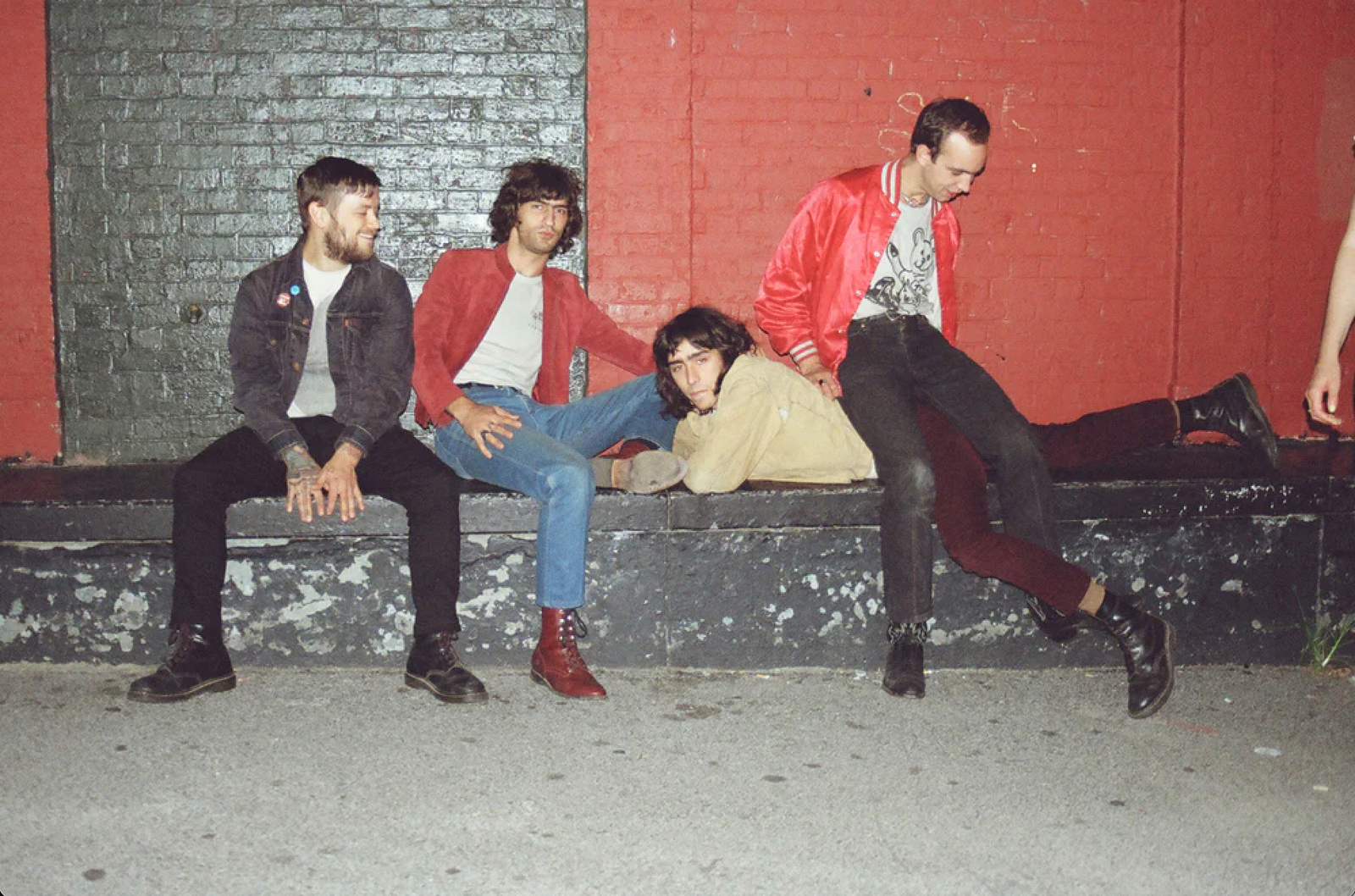
Institute is:
Barry Elkanick – guitar
Arak Avakian – guitar
Adam Cahoon – bass
Albert Limones – drums
Moses Brown – singing