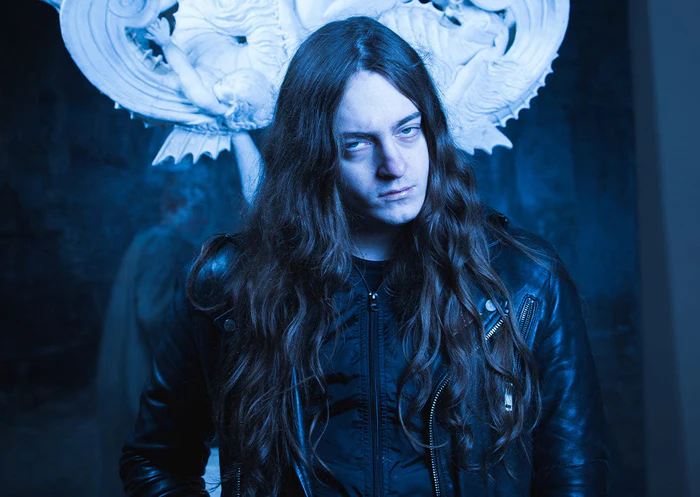
James Kent aka Perturbator makes his Nuclear Blast debut with a collection of post-punk disguised as retro-futurist synthwave.
Release date: October 10, 2025 | Nuclear Blast | Instagram | Facebook | Bandcamp
The 80s have been back in vogue for at least the last decade. Look no further than the runaway success of Netflix’s Stranger Things, which mined viewers’ nostalgia for a bygone era in a way that was immediately copied and milked dry for all its worth by the mostly throwaway likes of Ready Player One and The Electric State, while entire franchises like Star Wars and the Marvel Cinematic Universe revived previously dormant characters to appeal directly to the audience’s memories of (what they think was) a simpler time in their lives, like an old blanket that’s lost some of its softness but still retains a cozy warmth.
Perturbator, the alias of French multi-instrumentalist/producer/synthwaver James Kent, is no stranger to this backwards-looking cultural phenomenon. Since 2012, he has been releasing music – first independently, then with Finnish metal label Blood Music, and now with German heavy-hitters Nuclear Blast – that takes the distinct aesthetics of 80s-influenced synthwave and cranks up the intensity, adding some industrial metal and post-punk into the mix for good measure. While much of modern-day 80s internet nostalgia filters through what has come to be called ‘outrun’ aesthetics – Tron-esque computer gridlines, dark blue/purple color schemes, the occasional palm tree here and there – Perturbator‘s interpretation leans more toward a futuristic cyberpunk vibe, as evidenced by past song titles like “Neo Tokyo” (a reference to the classic Akira) and “Future Club”, all the while using retro-sounding synthesizers to build a sci-fi musical foundation for Kent’s songs.
While this could be called an indulgent novelty in a bygone musical style already mined by the classic likes of Vangelis, Tangerine Dream, and John Carpenter, the differences present in Perturbator‘s music show themselves in the thick, atmospheric touches. Every nook and cranny is filled with another layer, whether it be a synth melody, a percussive boom, or a guest artist bringing their own touch to Kent’s grimy metropolitan fantasies. Equally, Kent has increasingly worked in influence from other 80s genres like post-punk – New Order is an obvious inspiration for much dance-rock, but other bands like Echo and the Bunnymen and Siouxsie and the Banshees have made a definite impact known on his work (especially on 2021’s slower and moodier Lustful Sacraments). Even Perturbator‘s most recent project, 2022’s underappreciated Final Light, was a head-on collision with sludgy post-metal featuring Cult of Luna‘s guitarist/vocalist Johannes Persson. On his sixth full-length album, Age of Aquarius, he continues this trajectory, enlisting luminaries like Ulver and Alcest to help craft his vision of what may happen when this cyberpunk future he has soundtracked for nearly 15 years gains an additional layer of brooding, rain-soaked, leather-clad mystery.
“Apocalypse Now” opens the album with a glistening, mid-paced groove and Ulver‘s trademark sarcastic nihilism:
‘Our hearts grow cold
(Toxic seeds all around)
Another war to end all wars again
Apocalypse Now
(Toxic seeds all around)
There is blood on the ground
We’ve got bullets for everyone…’
The song’s bridge and outro feature percussion that sounds quite a bit like machine gun fire, a clear connection with the lyrical content. The song’s buoyant beats carry these clashing tones to the finish line with righteous regard – it’s danceable and grim, fun and bleak, all at once. It’s certainly an unexpected note to begin on, as the following “Lunacy” has more in common with Perturbator‘s older instrumental work: relentless drum machines, Health-esque synth swells, and an adrenalized pace to rival any hardstyle act for pure energy. It’s impossible to not feel the heart rate quicken while this one is playing, and by the time the synth layers begin falling away at the end, one is left completely breathless.
Some of the other downtempo experiments aren’t as exciting – “Venus”, featuring the usually enjoyable Author & Punisher, remains somewhat tuneless and plodding despite both artists’ efforts, while the interlude “Hangover Square” wears out its ambient welcome by going on for more than three minutes. “The Glass Staircase” fares much better with its subtly shifting time signatures and 808 rhythms keeping it moving unexpectedly from section to section. The superlative single “The Art of War” sounds like if Nine Inch Nails‘ “Heresy” stayed up all night on cocaine, the bags under its eyes covered by a pair of Terminator sunglasses and the gun barrel in its hand still white hot as it prowls through a seedy goth club. The overwhelming synth bass on this cut knocks one flat off their feet, crushing underfoot everything in its path.
Greta Link lends her ethereal vocals to “Lady Moon”, a waltzing stomper containing some spooky vibes that prove entertaining even though the lyrics are mostly gibberish (‘You’re a rule that never pleases me/Yeah, I make you and break you into a fantasy/Because its all for you, I swear, it’s not for me’). Meanwhile, “The Swimming Pool” proves to be another three-minute interlude with a more compelling structure than the previous one: simple chord progressions stacking one after another, before ending with a sample from such a quintessential 80s movie as Re-Animator. If “Mors Ultima Ratio” ends up sounding like Perturbator by-the-numbers, it’s only because it doesn’t necessarily showcase anything new for Kent and his trademark thundering sound – although still an enjoyable romp, even if it falls short of innovating.
However, the towering title track closes things with a whole album’s worth of ideas condensed into its ten-minute runtime. Perturbator‘s fellow Frenchman Neige of Alcest drops in to provide some of their signature vocal cooing while Kent gradually builds things up underneath him. Despite being another midtempo number, the attention to detail in the instrumental gives it a triumphant quality, like a great struggle is being met by one stubbornly determined individual. The song’s sole listed lyric, ‘Do you see me?‘, appears to reinforce this theme: the one-man band Perturbator, after over a decade of trying to find where the music of the 1980s intersects with how he imagines our future will look, is still searching for the answer through his work, putting out his research for the whole world to hear. If our future looks more hopeless these days than it does thriving and futuristic, it comes through in Age of Aquarius, itself named after the spiritual awakening that will supposedly unite humanity in peace and understanding in the years to come. Will we cast off the negativity and avert our incoming downward spiral into totalitarian rule, AI-afflicted ‘art’ pieces, and general nihilism? Maybe what we need is an apocalypse, now.