‘In a way, it’s the last true prog record the band would produce. There’s a variety of sounds that the following albums missed, but there are elements — particularly with the production — that laid the foundation for the juggernaut the band would become in the eighties.‘
-Steve Loschi
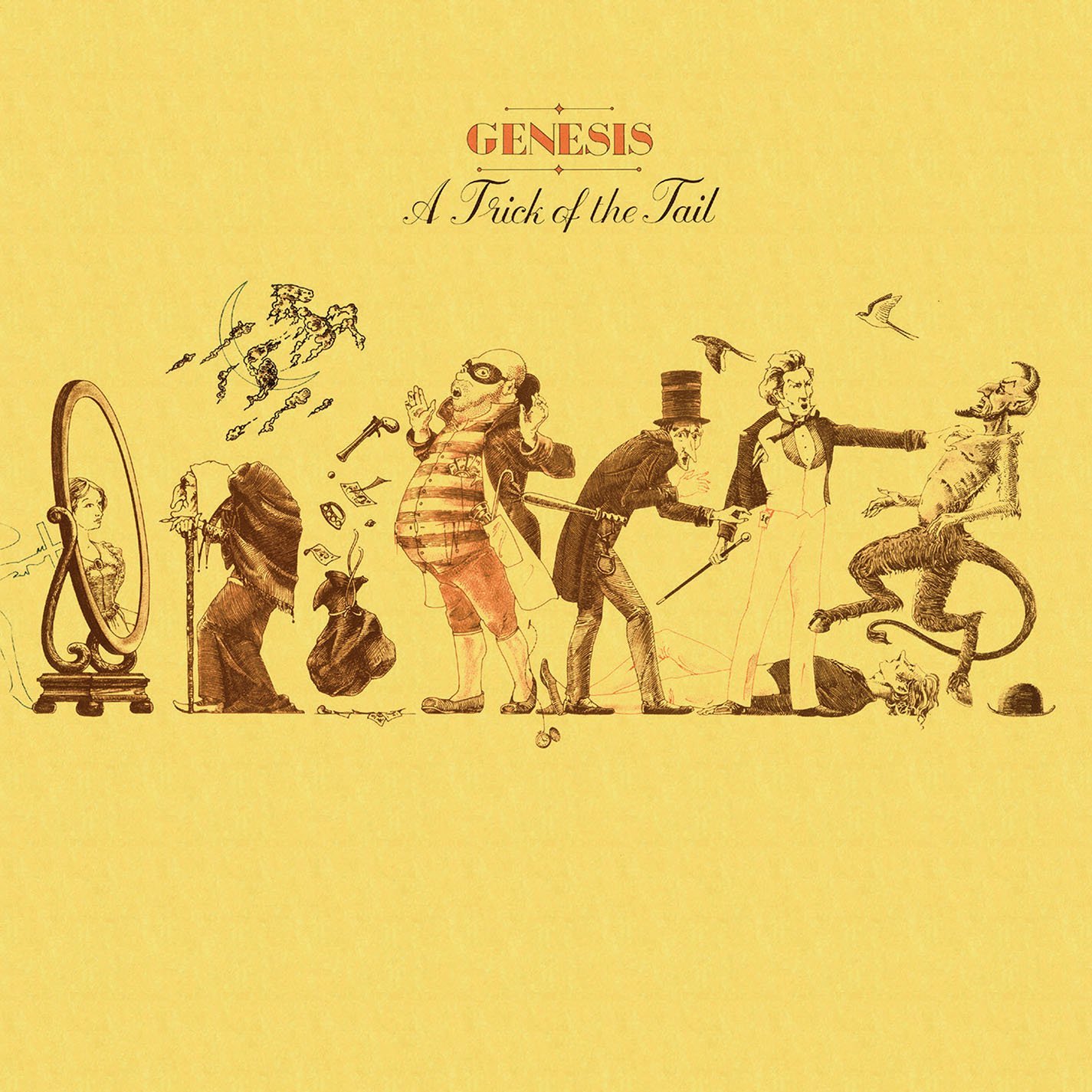
Release date: February 13, 1976 | Charisma / ATCO | Facebook | Instagram | Twitter | Website
Genesis have a bifurcated legacy: progressive rock veterans and MOR pop rock icons. While our team has mixed feelings on their later exploits, their era as one of prog’s most defining acts has many of us in a virtual chokehold to this day. A Trick of the Tail marks the metaphorical crossroads for the band, hinting at future decisions while retaining their original spark. Flexing their pop muscle for the first time, Genesis nonetheless delivered an epic, progressive feat.
Iain Ferguson
Nobody needs to waste their time listening to me attempting to wax poetic about how hard it is for a band to lose its public face. It’s a story as old as music itself, and come 1975, it was Genesis‘ turn to approach that hurdle. Fresh off touring their arguable progressive rock masterwork The Lamb Lies Down on Broadway, singer/frontman/one-man theater Peter Gabriel had (briefly) had enough with the music industry and retired. After wrestling over whether or not they should continue, considering going fully instrumental, and auditioning a multitude of singers, the band ultimately convinced Phil Collins to take over vocals. Come 1976, the four-piece took a stab at emerging from their former singer’s shadow with A Trick of the Tail.
Now, I should be clear about this fact; Genesis is probably my favorite band. Be it their progressive run in the ’70s, more streamlined albums in the ’80s, or even that one-off with Ray Wilson; I love most of their work. A Trick of the Tail was one of the first Genesis albums I heard in full, and it has always been one of my favorites. As far as the Collins-era goes, it is expectedly firmly progressive rock and the most beholden to their Gabriel-fronted years, tipping back towards the more folky, pastoral sounds of albums like Selling England by the Pound with a little of the muscle from The Lamb held over.
Most vitally, though; Genesis sounds completely confident and self-assured across A Trick of the Tail. Maybe opinions would have been different back when this album dropped, but there’s not a moment of this album where I can sense worry or trepidation about the band’s future written into the music. Opener “Dance on a Volcano” feels like a mission statement, navigating rapid musical shifts, chiming guitars, oozing bass, and a dizzying rhythm as Collins delivers lyrics feeling like an abstraction of the band’s do-or-die attitude at the time. It’s also one of the weightiest songs on the album, only really outdone by the Zeppelin-esque stomp of “Squonk” which recounts the story of a legendary critter from my home state of Pennsylvania who spent its days weeping over its own ugliness.
Meanwhile, the softer songs on A Trick of the Tail land just as well. “Entangled” is a folky cascade of beautiful 12-string guitars and harmonized singing which ends on a coda featuring possibly the most hauntingly beautiful use of a mellotron ever composed. “Mad Man Moon” proves a compact epic that stands as one of Genesis‘ more underrated songs (in my own opinion), while “Ripples” is yet another beautiful acoustic ballad bolstered by some of Collins’ finest singing and a haunting guitar lead from Steve Hackett in the bridge. It just pains me remembering such a beautiful song being the moment so many people left to use the bathroom or grab a beer at the Genesis concert I attended in 2007. But hey, can’t miss “I Can’t Dance”, right?
“Robbery, Assault, and Battery” feels like the closest Genesis comes to paying tribute to Gabriel, being a more theatrical narrative song featuring characters marked by different accents, but even then, it features a stellar keyboard bridge from Tony Banks and some nimble bass from Mike Rutherford. “A Trick of the Tail” proper is about as straightforward as the band got in this era, sign-posting the band’s eventual turn towards more conventional songwriting coming a few years down the road. Collins even gets to bring in some of his love for jazz fusion (more widely explored in his other band Brand X) on closer “Los Endos” which grooves along beautifully before bookending an album with a reprise of “Dance on a Volcano”.
Not a shred of A Trick of the Tail feels out of place. The songwriting is some of the best in the band’s career, and feels remarkably time-efficient for such a diverse progressive rock album with only one song even breaking the eight-minute mark. Phil Collins‘ voice had yet to solidify into that tone we all know him for now, but I honestly adore how he sounds across the album. The instrumental prowess of the band was never in doubt, but moving Collins behind the mic would in time lead to a surge in popularity that largely eclipsed their legendary earlier years.
Despite the situation Genesis found themselves in before A Trick of the Tail, the album would prove a fresh beginning for the band. Steve Hackett would hang in for one more album before bowing out, and the remaining trio of Banks, Collins, & Rutherford would again regroup before practically conquering the world through the ’80s with albums like Genesis and Invisible Touch. Genesis’ own chart success was also matched by Collins’ solo career (so ubiquitous that his retirement from music came with an apology for having been so popular) and that of former frontman Peter Gabriel. Mike Rutherford would have his own chart successes via Mike + the Mechanics, while Steve Hackett maintained a less commercial but musically outstanding solo career. Meanwhile, the shadow of Genesis‘ influence was cast wide and large, influencing bands as diverse and wide-ranging as Marillion, The Flower Kings, Iron Maiden, Enslaved, and a multitude of other bands.
Their earlier career was obviously legendary for all its own reasons, but 50 years on, A Trick of the Tail stands as the start of Genesis‘ second wind, and the earliest step in the run that would cement them not just as prog pioneers, but a genuine worldwide household name. A run that would eventually lead to people like myself, born after Genesis‘ final album with Collins was released, to look back at this album with its curious storybook sketch artwork, and wonder what it sounded like. To get lost in its passages, develop a love for the band, and share that love with any family and friends that would listen. A Trick of the Tail is a special album, a vital piece of history for Genesis and the wider progressive rock scene, and a font of warm nostalgia for those of us who found ourselves wrapped up in its melodies. Not bad for a band that wasn’t even sure they should continue.
Brandon Essig
Progressive rock was a formative influence for me back when I started getting into music, especially when I started playing drums. Rush was an obvious one, Kansas presented me with the more mainstream AOR version, and Yes provided quality material from their early work all the way into the 1990s (yeah I even enjoy 90125, sue me). One band I took a while to come around to was Genesis, although for not lack of exposure – my dad, a music industry veteran himself, would throw on a song or two from their poppier ’80s era in the car every so often, namely “Land of Confusion”. When I finally circled back to their ’70s output, I was shocked by how much more complex and appealing it was. In particular, the trilogy of Foxtrot, Selling England by the Pound, and The Lamb Lies Down on Broadway contain some of the best prog rock you’re likely to hear from that point in time, when progressive rock was still in its infancy as a distinct genre. Of course, losing a frontman as widely known as Peter Gabriel is a tall order for anyone, so how does Phil Collins’ first album as the singer for Genesis hold up?
Knowing that the band recorded the instrumentals for A Trick of the Tail without knowing who would end up singing over them gives a good idea of what to expect. Collins sounds a good deal like Gabriel on the album, perhaps wary of making the transition for fans an easy one. His drumming is as excellent as ever, easily evident on the opening “Dance On a Volcano”. Steve Hackett’s guitar and Tony Banks’s synth create a nervy, akilter mood before Collins and bassist Mike Rutherford give the song some bone structure. These verses are jagged, but maintain a clarity; when the chorus hits, Collins makes his presence as the vocalist felt, a melodic counterpoint to the odd time signatures he plays underneath. The song’s final leg winds up into a breakneck pace reminiscent of Collins’ instrumental side project Brand X, with fiery playing from Banks especially. It kicks off the second phase of Genesis with aplomb.
Acoustic-leaning cuts like “Entangled” and “Ripples…” provide the folksy quotient fans of the genre expect to break up the off-time zig-zagging. “Squonk” has a more straightforward groove while maintaining the band’s signature sound play, all while Collins tells a story about a hunter attempting to bargain with and capture the titular creature. The tongue-in-cheek lyrics allow some of these sillier topics to land with the listener; no doubt there are fans who prefer Gabriel’s more serious writing style, but Collins makes sure to include a variety of subject matter across A Trick of the Tail which holds interest. “Mad Man Moon” begins as normally as any rock song but transforms into a cosmic keyboard showcase for Banks, who stacks layer upon layer of warped tinkering that transports the listener into a psychedelic wonderland. When the rest of the band kicks back in, they are completely in sync, moving through odd time signatures and back again effortlessly. “Robbery, Assault and Battery” straddles both the prog and AOR vibes, with its strong melodies and vocal harmonies giving it pop appeal even while the players swirl and twist.
The title track has a pronounced Beatles-esque tone and personality, lightening the mood considerably into an optimistic, bouncy tune, while “Los Endos” closes A Trick of the Tail with some neon prog jamming, musical callbacks to “Dance On a Volcano”, and a final rhythm reminiscent of an interstellar death march. It goes to show that, even with the loss of Peter Gabriel, Genesis were able to push forward without him as a group with their creative vision intact. While the band’s subsequent discography (and Phil Collins’ solo career) contained a greater number of misses than they had to their name up until A Trick of the Tail, this album stands as both a statement of intent to continue their legacy and an assertion that Collins was an artist with a distinct voice. While Genesis officially put a wrap on their 55-year career in 2022 due to Collins’ ailing health, their music still sounds just as vital as ever before, and A Trick of the Tail stands as a monument to their perseverance and willingness to reinvent themselves. As Collins sings on “Ripples…”, ‘The face in the water looks up/And she shakes her head as if to say/That it’s the last time you’ll look like today.’
Steve Loschi
I’ve had an odd relationship with the music of Genesis my entire life. Their self-titled album from 1983 was one of my earliest favorite records. Coming on the heels of Duke and Abacab, the record was arguably the last ‘good’ Genesis record before they went off the rails with Phil Collins’ solo work and the atrocity known as Invisible Touch. Their subsequent Mama tour in 1984 was my first real concert, and to say it was life-changing for a fifteen year old kid wouldn’t be a stretch.
My exposure to early Genesis came after this introduction, which is kind of going through the back door to get to the front of the house. I was always intrigued by Peter Gabriel’s solo albums — he seemed to exist in this ethereal fantasy world that was both informed by the mystical and the real — and this made me feel as if I was able to peer into a world that few got to glimpse. Selling England By the Pound and The Lamb Lies Down on Broadway were the two Gabriel-era albums that spoke to me with that theatrical British twang, and are still two of my favorite records of all time.
Which brings us to 1976’s A Trick of the Tail. There was no telling where Genesis would go after the departure of Gabriel, but the Collins-led band showed they were more than up for the task. “Dance on a Volcano”, with its intricate time-signatures and Collins’s fat drums, and the psychedelic Pink Floyd-tinged “Entangled” seemed natural extensions of Selling England by the Tail, while the undeniable groove of some of the other songs led the groundwork for the more pop-centered music of Duke and Abacab.
“Squonk” was the first song Collins laid vocals down for. It was such a strong showing that the band was fine with Phil carrying the lead. Mike Rutherford’s bass locks into a sexy grapple with the Phil’s drums, and Tony Banks’s keyboards, as usual, seem such a natural part of the band and the sound that it’s hard to look at them as keyboards, as opposed to an organic off-shoot of the rhythm section.
In a way, it’s the last true prog record the band would produce. There’s a variety of sounds that the following albums missed, but there are elements — particularly with the production — that laid the foundation for the juggernaut the band would become in the eighties. The title track still holds on to the musical theater that belied the band’s Englishness back in the ‘70s, a kind of playful stab at carnival music. By the eighties, the band had moved on from this, as had most of the world. I suppose the ‘70s were, in some ways, a time to forget.
While A Trick of the Tail is far from my favorite Genesis album, it’s still a great one and an important part of the band’s discography. As for that show I saw when I was 15? They closed with “Los Endos”, before coming back for an encore of “Misunderstanding” and “Turn It On Again” — the end of a musical chapter before the triumphant return. All of us should be so lucky to get second lives like that.