


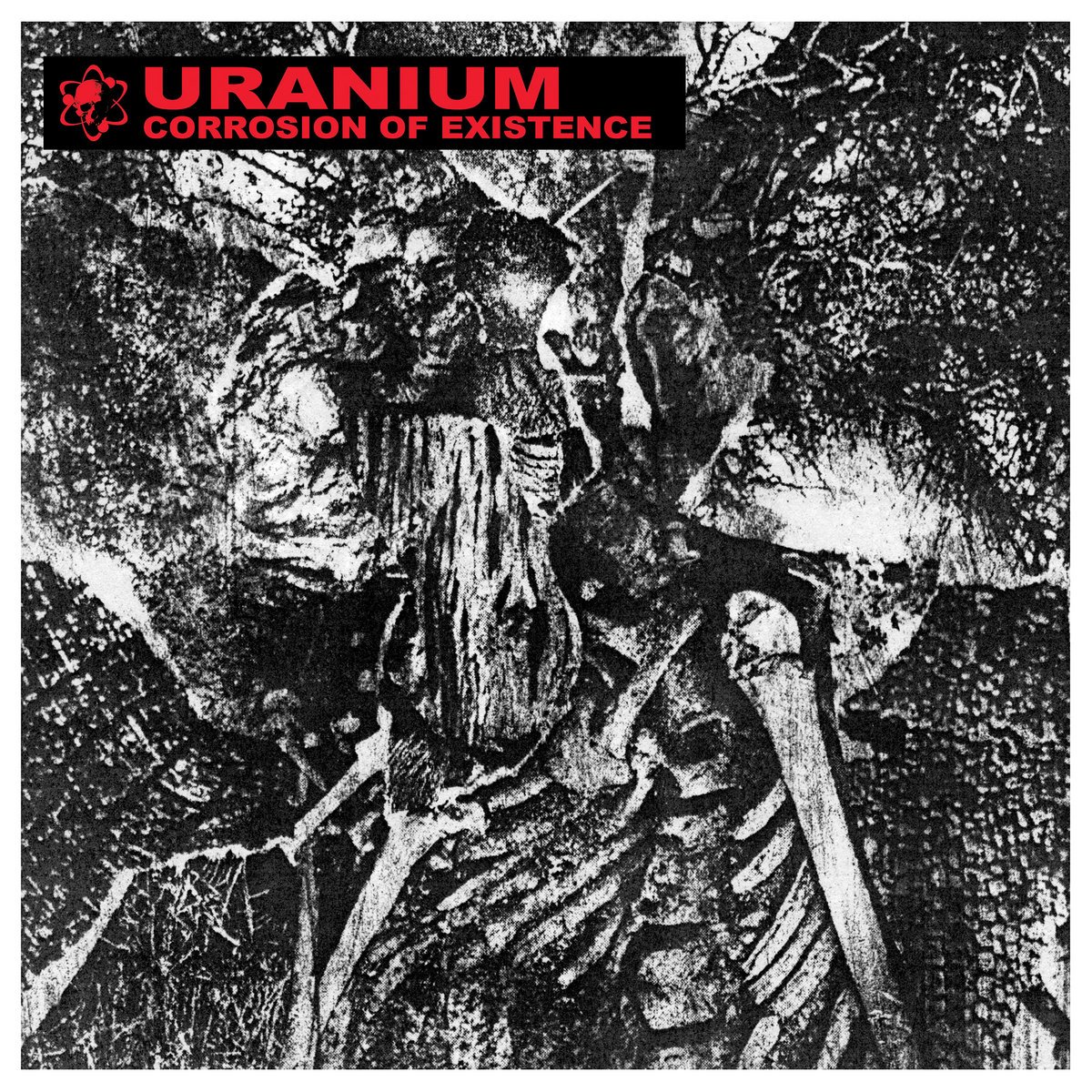
Uranium‘s metallic death industrial will reduce you to atoms, then split those atoms, on Corrosion of Existence.
Release date: November 7, 2025 | Sentient Ruin Laboratories | Bandcamp | Instagram
My experience with death industrial is limited. For me, it’s one of those genres that is always peeking over the horizon, tempting me with deep-fried samples and pulverizing power electronics. Yet for some unknown reason (probably my all-consuming obsession with metal), I’ve never managed to explore it beyond the surface level. My glimpses into it have all been with higher-profile modern artists – Lingua Ignota, Uboa, and The Body – who have managed to reach wider appeal. While these have been entertaining, I still feel a long way to go before truly understanding the allure of death industrial. But late at night perusing recent releases from Sentient Ruin Laboratories, I found the perfect opportunity to try a hidden gem.
There’s little information to be found online about this American solo project, but I do know that Uranium has the right style to draw me in to the unwelcoming genre of death industrial. Their music has plenty of the blown-out howls of power electronics that the genre is known for, but they also have some pounding metal riffs to keep things grounded. This is a nice draw for me, not just because I love metal but also because death industrial often loses me with its lack of a strong rhythm. On Corrosion of Existence, the metal elements include unsurprising Godflesh influence – enormous, droning industrial guitars cover much of the album – but also some blasting grindcore from time to time. In the hypnotic, repetitive song structures that Uranium employs, the occasional burst of grinding speed does a lot to keep things interesting.
Like most good noise-metal fusion acts, Uranium channels their oppressive sound to address the real-life horrors of a political issue. In this case it’s the threat of the total annihilation of humanity by nuclear warfare. This is by no means an original topic in heavy music, but I find Uranium’s approach to it particularly convincing. Plenty of metal bands, especially in thrash metal, have passionately reproached the existence of nuclear weapons to great effect, but it seems that metal on its own is incapable of directly evoking the experience of nuclear holocaust. No amount of skank beats and shouting can make us feel the lives disintegrated in seconds, the world choked with irradiated ash, the children born disfigured and the coffins lined with lead. Maybe no music could truly communicate this, but the concrete wall of blistering synths, distant shrieking effects, and grating guitars on Corrosion of Existence make me feel closer to nuclear winter than most music I can think of. Pondering the fractured, blackened skeleton on its cover doesn’t hurt either.
Corrosion of Existence makes its morbid intentions clear from the start. The opener, “Bliss and Void”, begins with a sampled broadcast of a man counting down from five to zero, and then lets loose the apocalypse. A shower of synths and searing electronics accompany cavernous, vitriolic growls, announcing the end of days. A single riff, distorted to the point of atonality and accented with booming drums, detonates its charge before collapsing into smoldering noise. At points it returns with a scathing vengeance, propelled anew by blast beats. It all comes together into this one great unified expression of unstoppable rage. To me, it sounds like the beginning of the end, the start of the chain reaction that leads to the elimination of all life. Whether this reaction is in the hearts of bombs, unstable nuclei shredding themselves into unfathomable destructive force, or between the hell-bent hearts of the leaders who would set them off, I cannot tell.
The album continues with the same terrible purpose that it began with. “Traffic Warden” and “Descent Into Entropic Death” are similarly searing displays of armageddon, with even simpler song structures. Then, as the third song announced, the rush of war falls away into the endless cold of post-radiation entropy, the true end of life. “Concrete Tombs” is the simplest song on the album, repeating the same pattern of low end noise and a synth motif for its whole duration. This sequence somehow gets imperceptibly slower and heavier every single time it appears, like the planet’s heartbeat itself descending towards the end, until it stops. The closing title track then is the most dynamic piece on the album. It revisits all the techniques Uranium has used up until this point and weaves them into a fresh twelve-minute journey: it starts with several minutes of noise before blast beats suddenly appear, then fade, then return with a vengeance. The ending uses a similar pattern of a synth motif to “Concrete Tombs”, but such incredible heaviness that it surpasses all that has come before. This final song disrupts the narrative flow of the previous ones, but its dynamic shake-up is nonetheless a welcome surprise.
Uranium’s exploration of the post-nuclear death of all life has a magnetic pull for me that I haven’t previously experienced with death industrial. This isn’t just because it uses more metal than the genre typically does, but because it feels so total. Every sound in every track works together to create an absolutely decimating aura of destruction. It isn’t just extreme, it’s immersive, and I find it so much more interesting than your average noise-metal fusion project. They didn’t even make me hear J. Robert Oppenheimer say ‘Now I have become death, destroyer of worlds’ for the billionth time. In a year that has lacked many standout industrial releases, I’m happy that I found such a powerful statement from the underground before 2026.





I really don’t know if Lingua Ignota or The Body can count as death industrial per se. They sometimes use elements of that genre, but not consistently enough. Pharmakon is probably the most mainstream example of someone who could be classified as death industrial. Kollaps & Trepaneringsritualen also include enough of that sound to perhaps qualify. Bands like Brighter Death Now and Atrax Morgue are the quintessential examples of death industrial, but if you’re looking for more rhythmic stuff I recommend:
Orphx: Fragmentation (includes lots of intense percussion rhythms & rhythmic noise, almost techno-like, but mostly far too brutal for a dancefloor. They later evolved into a rhythmic noise/powernoise & industrial techno group, but their 1993-96 era material is firmly in the realm death industrial, dark ambient, and the “noise” end of the rhythmic noise spectrum.)
MZ.412 – In Nomine dei […] & Burning the Temple of God
(probably the first group to describe their style as “black industrial/noise” – basically death industrial with black metal-inspires themes, at times incorporating actual black metal sounds, but more often evoking a “satanic” atmosphere in the idioms of death industrial, rhythmic noise, power electronics, dark ambient, and ritual & martial industrial)
Or you can go all the way back to the early 80s with old school industrial releases that would lay the groundwork for death industrial, such as:
SPK: ‘Information Overload Unit’ & ‘Leichenschrei’ (These are two of the absolute greatest industrial or noise albums ever made, especially Leichenschrei. Graeme Revell would go on to score The Crow and numerous other mainstream Hollywood slop)
Lustmord: s/t (now compiled on ‘Things That Were’) & ‘Paradise Disowned’ (The onetime SPK affiliate and the man synonymous with “dark ambient” also pioneered an early template of death industrial on his noisier first two albums.
Appreciate you leaving all these recs, I’ll have to get into some for sure! I was mainly going off of RateYourMusic tags to decide what counted as death industrial or not, but it seems like the more popular artists which use death industrial sounds aren’t the purest genre examples